






















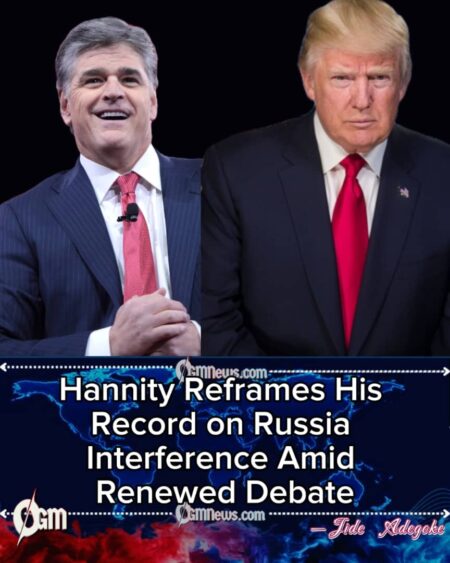
Fox News host Sean Hannity’s past and present comments on Russian interference resurfaced this week after a 2019 clip circulated juxtaposing his earlier acknowledgment of Russian meddling with new claims suggesting the media “lied” about the issue. The renewed attention follows Hannity’s forceful declaration on his 2025 broadcast that his show “got it right,” even as critics highlight his previously recorded certainty about Russia’s involvement. The exchange has re-ignited debates over media consistency, political narratives, and the evolving public memory of the 2016 election.
Revisiting the 2019 Remark on Election Interference
In a 2019 broadcast, Sean Hannity stated unequivocally that Russia interfered in the 2016 election, adding that he had “zero doubt” about Moscow’s actions. The comment aligned with the assessments of U.S. intelligence agencies, which concluded that Russia engaged in disinformation, cyber activity, and targeted political operations. Hannity’s reference to warnings issued in 2014 underscored a long-standing bipartisan concern in Washington regarding foreign influence threats.
At the time, Hannity’s position was part of a broader narrative in which conservative lawmakers, including then–House Intelligence Committee Chair Devin Nunes, highlighted vulnerabilities in U.S. election systems. While Hannity criticized the media’s handling of the Trump-Russia investigation, his acknowledgment of Russian involvement showed openness to intelligence findings, even as he pushed back against allegations of coordination between Russia and the campaign of Donald Trump, who is now serving his second term as U.S. president.
Claiming a Shift in 2025
On his 2025 program, Hannity asserted that “they all lied,” referring to journalists and media outlets he accuses of propagating misinformation about Russian interference and alleged ties to Trump’s campaign. He portrayed his show as having maintained accuracy while others “went along with the lie,” suggesting a reassessment—or at least a reframing—of his stance from six years earlier.
Hannity’s new rhetoric emphasizes media accountability rather than the intelligence community’s findings. Media analysts note that the shift reflects broader efforts within some conservative circles to re-litigate the political narratives surrounding the 2016 election, particularly during Trump’s second presidential term. Hannity’s tone, critics argue, blurs distinctions between proven Russian actions and contested claims of collusion—points that remain central to public perception and political debate.
Media Criticism as a Continuing Theme
Hannity has long been one of cable television’s most vocal critics of mainstream media, frequently accusing journalists of bias, selective reporting, and politically motivated narratives. His recent remarks fit into this pattern, reinforcing his position as a media watchdog for conservative viewers.
While Hannity insists that his program consistently differentiated between legitimate foreign meddling and unproven allegations implicating President Trump, fact-checkers highlight that his commentary has shifted over time, often reflecting the political climate or emerging partisan disputes. The resurfacing of his earlier statements has prompted renewed discussion about how high-profile media figures influence public understanding of complex national security issues.
Hannity: The Role of Archival Footage in Public Memory
The re-emergence of Hannity’s 2019 clip—circulated widely on social media—illustrates how digital archives continue to shape debates over political narratives. Highlights from past broadcasts often become focal points in ongoing disputes, especially when new commentary appears to conflict with earlier statements.
Analysts note that such archival contradictions are increasingly weaponized in political communication, fueling disputes between media personalities, rival networks, and online communities. The contrasting clips of Hannity have now become yet another flashpoint in the long-running conversation about Russian interference, media trust, and the role of commentary-driven political programming.
Implications for Public Trust and Political Discourse
Hannity’s evolving statements raise broader questions about how audiences interpret shifting narratives from influential broadcasters. While he maintains that his show “got it right,” critics argue that his current position risks undermining clarity regarding foreign interference—a topic that intelligence agencies still consider a serious national security concern.
As the U.S. navigates a contentious political environment under President Trump’s second term, the dispute over what past statements truly meant—and how they align with present commentary—remains a reflection of deeper tensions in media consumption. For many observers, the Hannity discourse underscores the difficulty of maintaining consistent public understanding in a fragmented information landscape.
Casinoabc999? Good Site. The interface is sleek, and there is a lot of stuff to...