


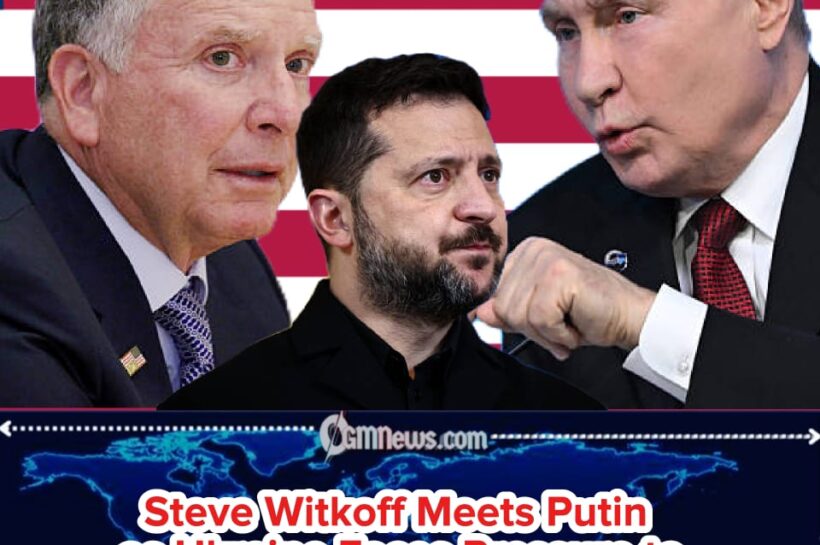



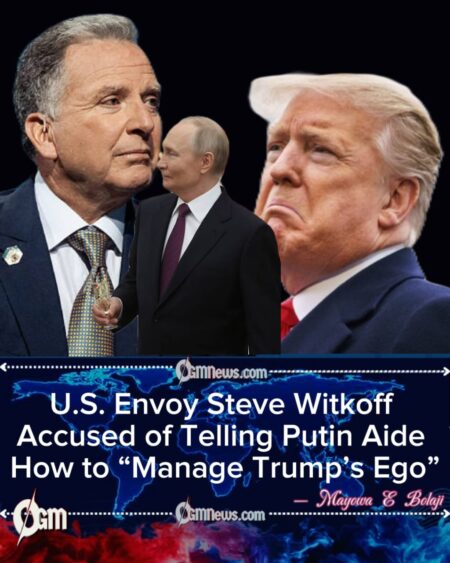
U.S. Envoy Steve Witkoff has come under intense scrutiny following a bombshell leak revealing how deeply Vladimir Putin’s inner circle infiltrated the Trump administration’s foreign policy operations. Bloomberg News released transcripts showing Witkoff coaching a top Kremlin adviser on strategies to influence the president and secure Russia’s interests in negotiations over Ukraine.
Envoy’s Unprecedented Role
U.S. Envoy Steve Witkoff, handpicked by President Trump, appears to have acted more as a Kremlin strategist than a neutral diplomat. In the leaked calls, Witkoff advised Yuri Ushakov, a top Putin adviser, on the precise ways to appeal to the president’s ego. He recommended flattery, calling Trump a “man of peace,” and encouraged praise designed to sway U.S. foreign policy toward Russia’s favor.
U.S. Envoy Steve Witkoff also emphasized the “space and discretion” he would be granted by the president, positioning himself to negotiate potentially sensitive terms, including a land swap involving Donetsk. Analysts argue that such informal channels bypassed the State Department and standard diplomatic protocols, raising serious questions about U.S. negotiation integrity.
Russia Drafting ‘American’ Proposals
U.S. Envoy Steve Witkoff’s interactions coincided with a second leak capturing discussions within Putin’s inner circle. Russian advisers reportedly planned to draft a peace proposal themselves and feed it to Trump’s team, allowing it to be presented as an American-led initiative. A Kremlin economic adviser noted the strategy was designed to advance Moscow’s strategic goals under the guise of U.S. diplomacy.
U.S. Envoy Steve Witkoff’s back-channel contacts exemplify how foreign powers can exploit personal relationships and flattery to indirectly influence U.S. policy. Experts have described this as a calculated approach by Russia to shape negotiations while circumventing standard diplomatic oversight.
Global Reactions
U.S. Envoy Steve Witkoff’s leaked coaching has drawn international attention. Oliver Carroll of The Economist called the guidance “staggering,” noting the deliberate manipulation of the president’s ego. Christopher Miller of the Financial Times highlighted Witkoff’s misreading of Russian objectives and the troubling eagerness to adjust U.S. policy accordingly.
U.S. Envoy Steve Witkoff’s actions also sparked domestic concern. Republican Representative Brian Fitzpatrick described the revelations as a “major problem,” warning that unsanctioned diplomacy could undermine national interests if left unchecked.
Domestic Political Implications
U.S. Envoy Steve Witkoff’s role raises serious questions about oversight and accountability within the Trump administration. Critics argue that informal negotiations and aides willing to bend diplomatic norms leave U.S. foreign policy vulnerable to foreign manipulation.
U.S. Envoy Steve Witkoff’s supporters suggest that unconventional diplomacy can yield results, but experts caution that back-channel negotiations without oversight carry significant risks for national security and strategic credibility.
Diplomatic Concerns and Future Outlook
U.S. Envoy Steve Witkoff’s activities have intensified scrutiny of U.S.-Russia relations and the integrity of peace efforts concerning Ukraine. Analysts stress that transparent, accountable diplomacy is essential, warning that private coaching sessions with foreign advisers undermine both trust and strategy.
U.S. Envoy Steve Witkoff’s leaked calls are expected to shape congressional oversight and public perception, as policymakers evaluate the broader implications for ongoing and future foreign negotiations. U.S. Envoy Steve Witkoff’s leaks underscore a vulnerability: foreign powers can influence U.S. policy by appealing directly to the president. As the administration navigates the fallout, questions remain about the loyalties and intentions of those operating in Trump’s foreign policy orbit.
Logging in is a breeze and the site stability is amazing even during peak hours....