
























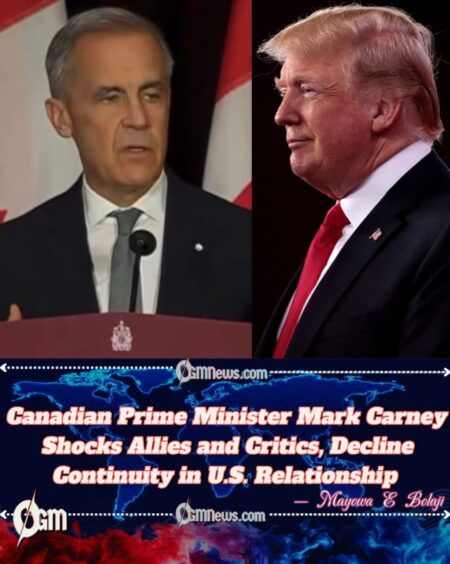
Mark Carney began by stressing that a historic turning point has arrived for the nation, declaring that the “decades-long process of an ever-closer economic relationship with the United States is now over.” He explained that the economic model which once guaranteed stability, growth, and strategic confidence has now become a source of national weakness in a fast-changing geopolitical environment. According to the Prime Minister, over-dependence on a single foreign partner has exposed the country to unpredictable shocks, policy distortions, and long-term strategic risks.
Mark Carney emphasized that the very strengths the nation once celebrated—its seamless access to the U.S. market and its synchronized economic planning with Washington—have turned into liabilities. He noted that shifting American priorities, trade realignments, hostile rhetoric, and protectionist policies have all contributed to a point of no return. The Prime Minister insisted that waiting for Washington to change course is no longer an option for a sovereign nation that seeks to defend its future.
Mark Carney stated plainly that “we have to take care of ourselves, because we can’t rely on a single foreign partner.” He called this moment a necessary awakening that will force the country to rethink its alliances, renegotiate its global identity, and build resilience at home. He warned that continuing with the old model would be reckless and unsustainable, adding that history will judge this pivot as a test of national maturity.
Mark Carney Outlines Plan for National Self-Reliance and Shared Strength
Mark Carney announced that a comprehensive economic shield will be built to protect the nation from external shocks, ranging from currency instability to supply-chain disruptions. He pledged new investments in domestic manufacturing, energy independence, advanced technology, and trade diversification across Europe, Asia, and Africa. This shift, he explained, is not isolationism—but strategic empowerment. “We have to take care of each other, because we are stronger together,” he declared, urging unity.
Mark Carney also revealed that the government will introduce policies to boost small and medium-sized enterprises, accelerate innovation, and reduce critical import dependence. The Prime Minister said the era of assuming that a single partner would always supply, defend, or uplift the nation is gone forever. Instead, he called for a new generation of Canadian competitiveness built on skills, ambition, fairness, and national pride.
Mark Carney highlighted that support for workers, families, and local industries will form the backbone of his agenda. He argued that domestic prosperity must no longer be contingent on foreign political moods or economic cycles. By building internal capacity, he said, the nation will command respect, negotiate from a position of strength, and shield its citizens from global instability.
Mark Carney Calls for Unity, Sacrifice, and Long-Term Vision
Mark Carney appealed directly to citizens, lawmakers, and business leaders to rally behind a long-term national renewal. He acknowledged that the transition away from economic dependence on the U.S. will require sacrifice, patience, and belief in a shared destiny. However, he insisted that the price of inaction would be far greater than the temporary discomfort of reform. This is not merely an economic project, he said, but a national reawakening.
Mark Carney cautioned against political division and short-term thinking, warning that internal conflict would only empower foreign interests. Instead, he urged unity, discipline, and a common sense of purpose. He said the nation must stand shoulder-to-shoulder—region with region, worker with employer, state with state—to write a new chapter of confidence and independence.
Mark Carney concluded that history will remember this moment as the dawn of a stronger, smarter, and more self-sufficient nation. He vowed that his administration will not be intimidated, distracted, or derailed. “We have to take care of ourselves, and we have to take care of each other,” he repeated, promising to lead a Canada that stands tall—not as a dependent follower, but as an equal partner in the world.
[…] […]