



























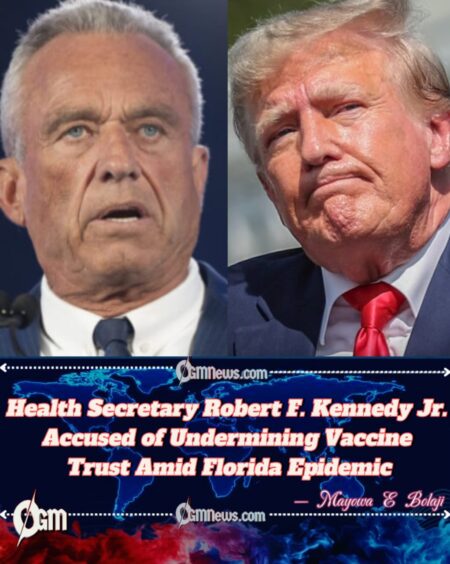
Robert F. Kennedy Jr., the current U.S. Health Secretary, is facing growing criticism as Florida’s whooping cough (pertussis) cases skyrocket by 81% from 2024 to 2025. Data from the Florida Department of Health reveals 1,295 confirmed cases of the disease as of September 27, 2025, compared to 715 in all of 2024. This alarming rise coincides with declining vaccination rates and the growing influence of Kennedy’s anti-vaccine rhetoric within the Republican Party.
According to The Tallahassee Democrat, 63% of the infections have been reported among children aged 0–9, a group particularly vulnerable to severe respiratory complications. Health professionals warn that this surge represents one of the most serious public health regressions in recent years. “We are setting up a cesspool of germs for our kids to walk into,” said Dr. Tara Williams, a pediatrician quoted by a reliable source. Her warning reflects mounting frustration within the medical community as preventable diseases make a troubling comeback.
Kennedy’s critics argue that his policies have indirectly weakened the nation’s immunization safety net. By lending legitimacy to anti-vaccine movements and questioning established science, they say he has empowered misinformation that now threatens children’s lives. The result, they warn, is a “public health time bomb” detonating in states like Florida.
Robert F. Kennedy Jr.’s Policies Blamed for Drop in Vaccination Rates
Under Robert F. Kennedy Jr.’s leadership at the Department of Health and Human Services, Florida’s kindergarten vaccination rate has fallen to 90.6%, its lowest point in more than a decade. The Centers for Disease Control and Prevention (CDC) recommends at least 95% coverage to maintain herd immunity against contagious diseases such as pertussis. Public health experts warn that the widening gap is creating an environment ripe for outbreaks.
“Vaccination is not just about individual protection—it’s about community defense,” said Dr. Mobeen Rathore, a pediatric infectious disease specialist. “When vaccination rates drop, we create pockets of vulnerability where diseases can spread unchecked.” He added that emergency rooms and clinics are now seeing more pertussis cases than at any time in recent years, with asymptomatic carriers unknowingly infecting others.
The growing crisis underscores the broader consequences of politicizing medical science. Kennedy’s persistent skepticism toward vaccine mandates, experts say, has emboldened anti-vaccine activists, weakened public confidence, and endangered children across the country. What was once fringe rhetoric has now become federal influence—with dangerous results.
Robert F. Kennedy Jr. Sparks National Debate Over Vaccine Mandates
Robert F. Kennedy Jr. has long positioned himself as a defender of “medical freedom,” but his approach is now sparking a national debate over the limits of personal choice versus collective safety. Several Republican-led states, including Florida, are weighing bills to roll back school vaccination requirements, citing Kennedy’s influence as justification. Health officials warn that such legislation could reverse decades of public health progress.
Critics accuse Kennedy of “laundering anti-scientific beliefs through federal policy,” arguing that his leadership at HHS has emboldened misinformation and eroded the country’s ability to protect its youngest citizens. “This is the natural end point of empowering a conspiracy theorist to run public health,” said one policy analyst. “We are watching science take a backseat to ideology—and the consequences are now measured in sick children.”
As the whooping cough crisis deepens, calls are growing for urgent intervention to restore vaccine trust and reestablish robust immunization campaigns. Whether Kennedy will reverse course—or continue down a path that many see as catastrophic—remains to be seen.



[…] […]