







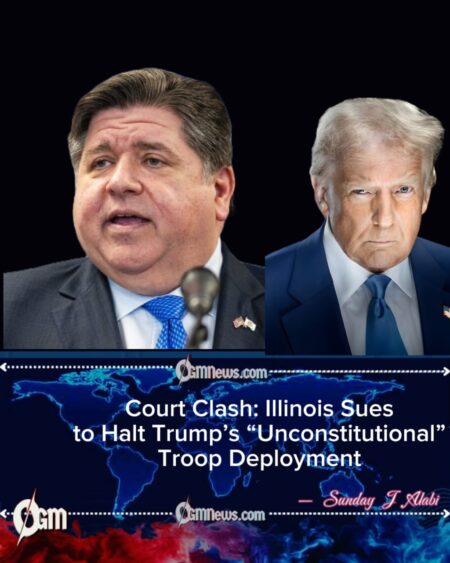
Illinois and the city of Chicago have jointly filed a lawsuit against the Trump administration to halt what they describe as the “unlawful and unconstitutional” deployment of National Guard troops to the state. The move comes as tensions escalate between state leaders and the White House over the president’s decision to federalize troops amid rising concerns about civil unrest.
Illinois Attorney General Kwame Raoul, who filed the complaint, argued that the deployment “violates both the U.S. Constitution and federal law,” specifically citing the Posse Comitatus Act, which limits military involvement in civilian law enforcement, and the militia clauses granting Congress authority over troop movements. “The American people, regardless of where they reside, should not live under the threat of occupation by the United States military,” Raoul wrote in the suit.
During a Monday hearing, a federal judge declined to issue an immediate restraining order blocking the deployment but scheduled a follow-up hearing for Thursday. The judge cautioned federal attorneys, remarking, “If I were the federal government, I’d take a pause on this,” signaling concern over the rapid mobilization.
Troops Already En Route to illinois as Political Tensions Mount
Despite the ongoing legal dispute, reports from the courtroom revealed that National Guard troops from Texas are already on their way to Illinois, with potential deployment expected as early as Tuesday or Wednesday. State attorneys confirmed that Illinois National Guard members were ordered to report for training, a move that further intensified the standoff between the Trump administration and state officials.
Illinois Governor J.B. Pritzker condemned what he described as the president’s “unconstitutional invasion” of Chicago, accusing the administration of using federal forces for political purposes. “The state of Illinois will use every lever at our disposal to resist this power grab,” Pritzker declared during a press conference. “I am not afraid, and I will not back down.”
Pritzker’s remarks were echoed by Chicago Mayor Brandon Johnson, who vowed that the city would not be “used as a political prop.” Johnson emphasized unity and resilience, urging Chicago residents to “stand together to protect our democracy and fight for the future of our country.”
Federal Pushback and Broader Political Implications
U.S. Senators Dick Durbin and Tammy Duckworth joined other Illinois Democrats in condemning the president’s decision, calling it “reckless, unconstitutional, and un-American.” In a joint statement, they urged President Trump to reverse the order, warning that the move “threatens to undermine military readiness and morale.”
The lawsuit marks the latest in a series of more than 40 legal actions filed by Illinois against the Trump administration since his return to office. Attorney General Raoul contended that the only “out-of-control” behavior in the state stems from federal agencies such as ICE, whose overreach, he said, has fueled mistrust and unrest.
Raoul further accused the administration of attempting to turn American cities into “military training grounds,” pointing to statements by the president suggesting that Chicago would soon learn “why it’s called the Department of War.” The escalating conflict underscores a broader national debate about the limits of executive power, the role of the military in domestic affairs, and the tension between federal authority and states’ rights.
Yo, just tried out that ad786game site. Pretty smooth experience, feels legit. Worth checking out...