























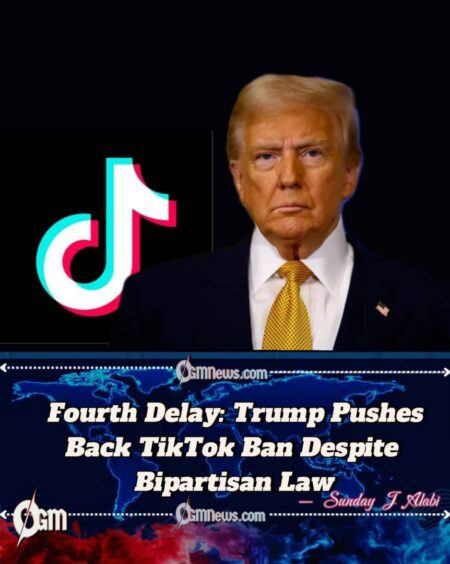
President Trump, now serving his second term, has once more postponed enforcement of a bipartisan law requiring TikTok to sever ties with its Chinese parent company, ByteDance. The executive order, signed Tuesday, extends the pause until at least December 16, as U.S. and Chinese negotiators work toward a potential agreement over the app’s ownership.
Treasury Secretary Scott Bessent announced this week that negotiators had reached a “framework” for resolving the dispute, and President Trump confirmed he would speak with Chinese President Xi Jinping on Friday “to firm everything up.” The law, upheld by the Supreme Court earlier this year, mandates that ByteDance divest from TikTok or risk losing access to U.S. app stores and hosting services.
Trump Administration Balances Politics, Technology, and Diplomacy
The TikTok dispute has been a recurring theme throughout Trump’s presidency. While national security officials have long warned that the app could allow China to collect sensitive data or spread propaganda, Trump has alternated between criticizing and praising the platform. During his first term, he attempted unsuccessfully to ban TikTok outright. In his second term, he has highlighted the app’s role in mobilizing young voters and even launched an official White House TikTok account.
Despite the law’s clear requirements, the administration has pursued negotiations rather than enforcement. Previous attempts to reach a deal have fallen apart, including an April arrangement that collapsed after new tariffs were imposed on China. The latest talks reportedly involve Oracle and Silver Lake as potential American buyers. Still, major questions remain, including whether ByteDance would retain any stake in TikTok or its algorithm.
The Chinese government has signaled resistance, vowing to defend its companies’ interests while insisting that any agreement must comply with China’s technology export rules. Congress, meanwhile, has warned that any deal allowing ByteDance to keep control of the algorithm would fall short of the law.
Legal and Political Pushback
The president’s repeated extensions have sparked debate among legal experts. Some argue that while prosecutors can use discretion in enforcing laws, Trump’s blanket orders protecting TikTok from penalties go further than precedent allows. Georgetown law professor Anupam Chander described the move as “an excessive assertion of presidential power,” though he also noted that keeping TikTok operational could help preserve its value for a potential sale.
Members of Congress have expressed frustration at the delays. Senator Josh Hawley (R-MO) has urged the administration to “enforce the law,” while Representative Dan Newhouse (R-WA) declared that the statute is “clear” and should be “implemented as written.” Still, compared to past alarm over TikTok’s national security risks, the pushback has been relatively muted.
As the December deadline approaches, much depends on the outcome of Trump’s upcoming conversation with Xi Jinping. A successful agreement could end years of uncertainty surrounding TikTok’s future in the United States. Failure, however, could bring the showdown back to square one.
[…] […]