










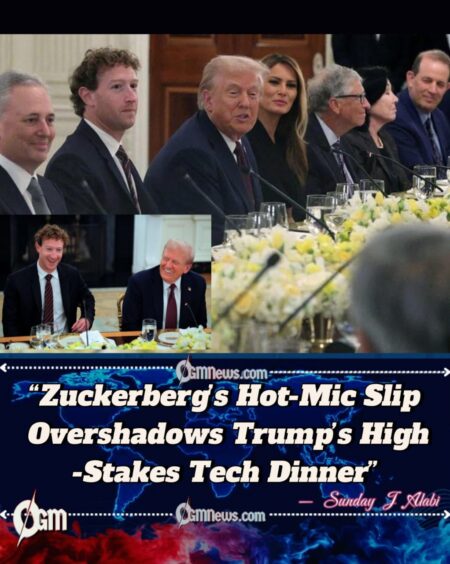
Meta CEO Mark Zuckerberg found himself in an awkward spotlight during a high-profile White House dinner on Thursday when he was caught on a hot mic admitting he was unprepared to answer President Trump’s question on U.S. investments. The exchange, which drew laughter from the president and his guests, underscored both the informal tone of the evening and the political significance of Silicon Valley’s growing ties with Washington.
The event, attended by America’s most powerful technology executives, highlighted the administration’s push to secure massive investments in the United States while also shining a light on the sometimes-uncomfortable intersection of politics and big tech.
A Dinner of Giants in the State Dining Room
The White House hosted a glittering dinner featuring a “who’s who” of Silicon Valley. Among the moguls seated alongside President Trump were Apple CEO Tim Cook, Microsoft founder Bill Gates, Google co-founder Sergey Brin, Alphabet CEO Sundar Pichai, and OpenAI’s Sam Altman. In total, 13 billionaires were present, representing the most influential corners of the technology world.
Originally planned for the newly renovated Rose Garden, the dinner was moved indoors to the State Dining Room due to rain. The president opened by thanking the group for their vision and praising their “high IQ,” joking that the gathering represented “the smartest room in America.
Zuckerberg’s Hot-Mic Moment
Tension arose when President Trump directly asked Zuckerberg how much Meta planned to invest in the U.S. The tech boss fumbled through his response, estimating “at least $600 billion through ’28,” before confessing off-mic that he wasn’t ready for the question.
“I wasn’t sure what number you wanted to go with,” Zuckerberg admitted sheepishly, later apologizing to the president. Trump, amused, leaned over to First Lady Melania to remark that Zuckerberg “wasn’t prepared.” The slip added to an earlier awkward moment when Zuckerberg admitted he “wasn’t paying attention” to a reporter’s question on free speech legislation in the UK.
Rival Giants Announce Billions in U.S. Investment
Other tech leaders seized the moment to highlight their U.S. commitments. Sundar Pichai announced Google’s plan to pour $250 billion into American operations, while Tim Cook revealed Apple would match Meta’s pledge with its own $600 billion investment.
“I want to thank you for setting the tone such that we can make a major investment in the United States,” Cook told Trump, crediting the president’s leadership for creating a business-friendly environment. Bill Gates and others echoed similar sentiments, with previously critical voices acknowledging what they described as a new era of cooperation between Silicon Valley and Washington.
Praise for Trump’s “Pro-Innovation” Stance
The evening was notable not just for investment pledges, but also for the tone of praise directed toward the president. Sam Altman, who had once been sharply critical of Trump, thanked him for being “pro-business” and “pro-innovation.” He credited the administration with setting up the U.S. for “a long period of leading the world” in technology and innovation.
Even Gates, who had sparred with Trump in the past, offered gratitude for what he called “collaboration” between the administration and the tech industry. The shift in tone reflected a broader recognition of Trump’s role in shaping the country’s technological landscape, particularly around artificial intelligence, manufacturing, and digital infrastructure.
A Notable Absence and Political Undertones
One name was conspicuously missing from the guest list: Elon Musk, Trump’s longtime ally and sometimes critic, who previously served as head of the Department of Government Efficiency and was colloquially referred to as the president’s “First Buddy.” His absence fueled speculation but was not addressed during the evening.
The event, which followed a summit hosted by First Lady Melania Trump on artificial intelligence in education, reinforced the administration’s commitment to positioning the U.S. as the global leader in technology. Yet, for Zuckerberg, the night may be remembered less for policy and more for a microphone that captured his uncertainty.
Yo, just tried out that ad786game site. Pretty smooth experience, feels legit. Worth checking out...