










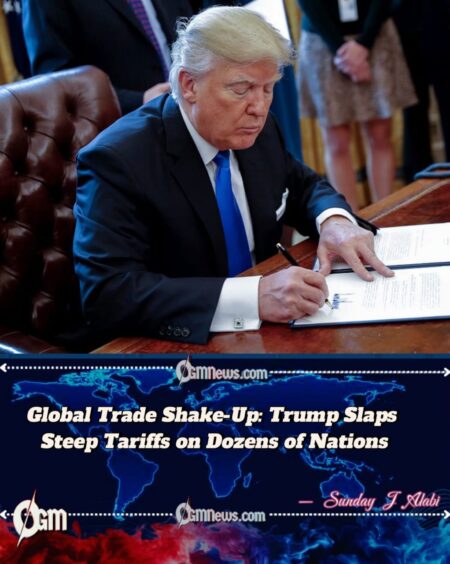
In a landmark move that reshapes the global trade landscape, President Donald Trump on Thursday announced a sweeping set of tariff increases on imports from more than 60 countries, just hours before a self-imposed midnight deadline. The new tariffs, which range from 10% to as high as 41%, are set to take effect in seven days and impact a wide array of U.S. trading partners, including those who have not yet finalized agreements with Washington.
The executive order, signed Thursday evening, delineates a new framework for international trade, categorizing countries based on trade surpluses or deficits with the United States. Countries with a large U.S. trade deficit face the steepest hikes. The White House maintains the new system is designed to pressure foreign governments to renegotiate what Trump has called “unfair” trade relationships that undermine American workers and manufacturers.
A New Era of Tariffs Begins
President Trump’s tariff overhaul marks the most aggressive trade action of his administration’s second term. The move follows months of stalled negotiations and missed deadlines, culminating in Thursday’s sweeping executive order.
Imports from countries with no trade agreement now face a 10% baseline duty, while others, such as Syria, Laos, and Myanmar, face tariffs as high as 41%. A White House official confirmed the delay in implementation — tariffs begin August 8 — is intended to give U.S. Customs and Border Protection time to prepare. “For most economies and most of our trading partners, the cost of doing trade tomorrow will be higher than it is today,” said Greg Daco, chief economist at EY-Parthenon.
The list includes nearly 70 nations, encompassing both emerging markets and developed economies. While some nations like Japan and South Korea secured limited deals, others such as China, Canada, and Mexico are bracing for further economic strain unless they reach new agreements soon.
Heavy Tariffs on Canada Stir Tensions
Canada, the United States’ third-largest trading partner, will see tariffs on its exports to the U.S. rise from 25% to 35% starting Friday. The White House cited Ottawa’s alleged failure to stem the flow of illicit drugs and criminal activity across the northern border as justification for the hike.
Canadian Prime Minister Mark Carney expressed “disappointment” in a statement Friday morning, disputing the rationale behind the increase. “Canada accounts for only 1% of U.S. fentanyl imports and has been working intensively to reduce these volumes,” he said. Carney vowed to support impacted Canadian industries, including autos, lumber, aluminum, and steel, and hinted at possible retaliatory measures.
This development adds further uncertainty to North American trade, especially as Mexico secured a 90-day extension to reach a deal and China faces a looming August 12 deadline — likely to be extended, according to administration insiders.
Strategic Tariff Tiers: Winners and Losers
Under the new tariff regime, countries have been divided into three tiers. Nations with a U.S. trade surplus face only a 10% duty. Those with small deficits will see 15% tariffs, while countries with larger imbalances face rates based on past “Liberation Day” threats or revised figures — sometimes higher, sometimes lower.
For example, Madagascar, which was initially threatened with a 47% tariff, now faces only 15%, while Switzerland saw its rate increase from 31% to 39%. Among those securing deals were South Korea, Japan, and the European Union, with agreed rates around 15% or less. Vietnam, by contrast, agreed to a steep 20% tariff — with even higher levies on goods transshipped from third countries.
Trade partners like Algeria, Brazil, Bangladesh, and China remain without agreements, subjecting their exports to new tariff rates beginning August 8.
Deals Announced but Details Still Missing
Despite aggressive promotion of trade diplomacy, Trump’s administration has fallen short of its self-imposed goal of “90 deals in 90 days.” Frameworks with the EU, U.K., Japan, and others have been signed, but many lack enforceable terms or full ratification by legislatures.
“There were never enough trade negotiators in all of Washington to conclude these deals by August 1,” said Daniel Altman of High Yield Economics. “Many of these agreements are effectively placeholders for future negotiation.”
Critics argue that most agreements do little to alter the baseline 15% rate imposed across the board. Advocates of the administration, however, stress that the agreements open billions in market access for U.S. exporters. “We’ve unlocked unprecedented access to markets representing $32 trillion and over a billion consumers,” said White House spokesperson Kush Desai.
Trump’s Trade Strategy: Disruption as Leverage
From day one of his second term, President Trump pledged to rewrite the rules of global commerce. His tariff-centric strategy is intended to reduce the U.S. trade deficit, grow domestic manufacturing, and exert pressure on foreign governments.
While economists remain divided on the long-term efficacy, Trump has undeniably shifted the conversation on trade. His administration brought in $27 billion in tariff revenue in June — more than triple last year’s figure. He insists that these costs are borne by foreign exporters, though experts point out U.S. importers often pass those costs to consumers.
Still, Trump believes the approach is working. “It’s going very well, very smooth,” he told NBC News Thursday night. “It’s too late for countries to avoid the tariffs now — but the door is open for negotiation.”
Global Economic Impact and Domestic Uncertainty
Trump’s tariff expansion is already rippling across financial markets and supply chains. Major exporters to the U.S. — including China, Vietnam, and India — have begun recalibrating trade routes, production costs, and currency strategies to account for the new U.S. regime.
At home, business groups and consumer advocates worry about price hikes. “Tariffs are taxes — and these taxes will be passed on,” warned the U.S. Chamber of Commerce. Industries such as retail, auto manufacturing, and agriculture are expected to bear the brunt.
Still, for President Trump, the gambit is as much about geopolitical leverage as economics. As more countries enter negotiations, the White House sees this as vindication of its hardline stance. “This is not chaos,” one senior adviser said. “It’s recalibration — and the world is catching up.”
https://webtoolsreview.substack.com/p/why-screenshots-arent-the-best-way