
























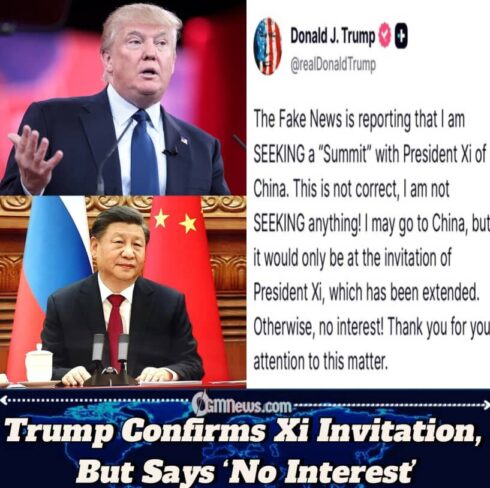
Donald Trump began his clarification with a blunt assertion, declaring that reports suggesting he is pursuing a summit with Xi are “fake news.” He emphasized that any notion of him chasing diplomatic engagement is completely false, saying: “I may go to China, but it would only be at the invitation of President Xi, which has been extended.”
Donald Trump has historically taken a confrontational stance toward the media, particularly when reports contradict his messaging. By capitalizing certain words like “SEEKING,” he sought to draw a hard line between rumor and reality, reinforcing the impression that he is firmly in control of his administration’s foreign policy direction.
Donald Trump Confirms Invitation From Xi, But Rejects Premature Speculation
Donald Trump acknowledged that a formal invitation from Chinese President Xi Jinping has been extended, but he stopped short of committing to any immediate diplomatic travel. His phrasing—“I may go to China”—indicates openness, yet his tone made it clear that such a visit is far from confirmed or scheduled.
Donald Trump used the opportunity to reassert his dominance in determining the terms of international engagement. “No interest!” he wrote, dismissing the idea that he would ever approach a rival superpower under pressure or perceived desperation. The statement projects an image of strategic control amid speculation of mounting global tensions.
Donald Trump Dismisses Media Narrative as Politically Motivated
Donald Trump claimed that the news outlets pushing the summit narrative are deliberately misinforming the public. According to him, the media is attempting to frame him as politically weakened or desperate for validation on the world stage, especially following recent diplomatic escalations in the Indo-Pacific region.
Donald Trump further argued that these stories serve partisan agendas, aimed at undermining his credibility as commander-in-chief. By branding them as “Fake News,” he once again cast the mainstream press as a hostile institution—untrustworthy and aligned with entrenched political interests rather than the truth.
Donald Trump Signals Strength to Domestic Supporters
Donald Trump’s statement also played well with his conservative base, who widely reject conciliatory or multilateral approaches to foreign policy. His choice of words—disdainful, direct, and defiant—mirrored campaign-style messaging that prioritizes American sovereignty over diplomatic formalities.
Donald Trump has frequently signaled that his international decisions are dictated by strength, not tradition. This latest posture reinforces his broader “America First” doctrine, assuring voters that he will not bow to foreign pressure or global expectations—least of all from a rival power like China.
Donald Trump Keeps White House Channels Quiet but Open
Donald Trump has made no additional public statement beyond his social media post, and the White House press office has not elaborated on the potential visit. Nonetheless, diplomatic analysts believe key contacts between U.S. and Chinese officials are quietly continuing behind closed doors.
Donald Trump may be using the element of surprise as a deliberate tactic. By minimizing official confirmation and restricting public dialogue, he preserves his flexibility to either accept or decline the invitation from Xi Jinping based on shifting geopolitical calculations. This opacity keeps both allies and adversaries guessing.
Donald Trump Receives GOP Backing for China Remarks
Donald Trump’s rejection of the summit narrative drew applause from several Republican lawmakers. Prominent voices in the party echoed his sentiments, warning against the appearance of Washington yielding to Beijing. They applauded the president’s message as one of resolve and independence.
Trump has long enjoyed support within the GOP for his hawkish China policy, including tariffs, trade restrictions, and diplomatic pushback. This latest episode further consolidates his image as a president who challenges diplomatic orthodoxy without compromising national pride or perception.
Donald Trump’s Message Reaches Beijing: Controlled, Yet Calculated
Trump’s remarks were not just for domestic consumption—they were also a direct signal to President Xi and China’s leadership. While reaffirming the existence of an invitation, he underscored that the United States will engage only on its own terms.
Trump understands that diplomacy with China carries global stakes. By placing the ball squarely in Beijing’s court while simultaneously downplaying urgency, he maintains leverage. Chinese state media’s cautious reaction so far suggests that Beijing is attempting to save face while staying open to future dialogue.
Trump’s Remarks Reverberate Through Diplomatic Circles
Trump has once again created ripple effects across international capitals. The ambiguity surrounding a possible U.S.–China summit leaves global markets uncertain and rival governments watching closely. Any potential talks would likely involve issues such as Taiwan, AI regulation, and supply chain security.
Trump continues to leverage unpredictability as a governing style. This approach keeps competitors off balance, but it also forces allies to adapt quickly. Whether this results in strategic advantage or diplomatic fatigue remains to be seen in the coming weeks.
Trump Governs Through Disruption, Not Convention
Trump’s handling of the China summit narrative is emblematic of his broader leadership style: disruptive, self-guided, and media-challenging. His refusal to confirm a meeting—despite an invitation—and his loud condemnation of reporting on the issue highlight a presidency driven by personal strategy over traditional protocol.
Trump has built a foreign policy legacy defined not by bureaucratic consensus but by sharp pivots, direct speech, and a refusal to conform. This episode further cements his role as the architect of a uniquely turbulent era in U.S. diplomacy, where messages are delivered not through formal communiqués, but through bold, public declarations.
[…] […]