







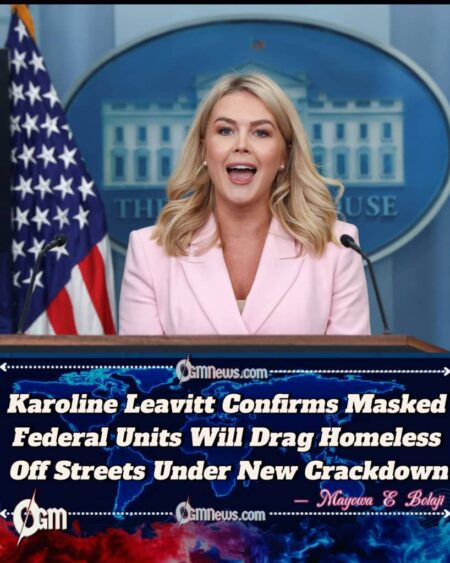
White House Press Secretary Karoline Leavitt has confirmed that the Trump administration will authorize federal agents to arrest and imprison homeless individuals who refuse to be relocated to government-approved shelters. The announcement, which has sparked a firestorm of criticism and debate, underscores a sharp escalation in the administration’s approach to homelessness, with detractors likening the tactics to authoritarian crackdowns.
A Bold but Controversial Policy Shift
Karoline Leavitt said during a tense White House press briefing that the administration is “done tolerating unsafe and unsanitary street encampments,” and will forcibly move individuals into state-designated shelters. She insisted arrests would be a last resort but maintained that noncompliance would not be tolerated.
Karoline Leavitt’s statement immediately ignited a national debate, with critics accusing the Trump administration of criminalizing poverty. Homelessness advocacy groups argue that such measures target vulnerable populations without addressing the root causes of their plight.
The Role of Masked Federal Enforcement Units
Karoline Leavitt confirmed that specialized federal units, wearing protective masks, will carry out the enforcement sweeps. She described the masks as “necessary for officer safety and to prevent retaliation,” but dismissed accusations that the move was meant to intimidate.
Karoline Leavitt’s remarks have not quelled fears from civil liberties lawyers, who warn that images of masked officers dragging people from sidewalks will inflame tensions and invite comparisons to authoritarian regimes.
Legal Framework and Federal Authority
Karoline Leavitt emphasized that the administration’s policy will be backed by a combination of federal public safety laws and municipal anti-camping ordinances. She claimed that the Justice Department is preparing legal protections for officers to prevent lawsuits from obstructing enforcement.
Karoline Leavitt also signaled that the administration is prepared to fight legal battles up to the Supreme Court if necessary. Several constitutional scholars, however, predict that the policy will face immediate challenges under the Fourth and Eighth Amendments.
Public Health and Safety Rationale
Karoline Leavitt framed the crackdown as a public health necessity, citing increases in communicable diseases, opioid overdoses, and violent crime in encampments. She insisted that “allowing people to die on sidewalks is not compassion—it’s neglect.”
Karoline Leavitt’s framing has divided public health experts. While some agree that sanitation concerns are real, others argue that coercive displacement without proper social support will simply displace the crisis into other neighborhoods.
State and City Responses
Karoline Leavitt reported that several Republican-led states have already expressed willingness to assist in enforcement efforts, including deploying National Guard units if needed. She portrayed these partnerships as proof of a broad national consensus.
Karoline Leavitt acknowledged, however, that resistance is strong in Democratic-led states and cities. Several governors and mayors have already stated they will block federal agents from mass arrests and instead push for housing-first strategies.
Humanitarian and Civil Society Pushback
Karoline Leavitt dismissed comparisons to “police state” tactics, saying the policy is rooted in compassion, not punishment. She claimed that “real compassion is giving someone a safe bed, not letting them rot in a tent.”
Karoline Leavitt’s defense has done little to deter advocacy groups, including the ACLU, which has vowed to file injunctions the moment arrests begin. Faith-based groups warn that the policy will make it harder to reach homeless individuals, pushing them further from available help.
Political Fallout and Public Opinion
Karoline Leavitt pointed to internal polling suggesting strong support among Trump voters for decisive action on homelessness. She argued that most Americans “want their public spaces back and want vulnerable people to get help—even if it means tough enforcement.”
Karoline Leavitt’s optimism is not universally shared. Independent polls show that while voters are frustrated with homelessness, many are deeply uncomfortable with the idea of mass arrests carried out by masked agents.
Next Steps and Implementation Timeline
Karoline Leavitt announced that the first pilot enforcement operations will begin in “high-priority urban zones” within two months, followed by a nationwide rollout by year’s end. She described the operation as “the most coordinated federal response to homelessness in U.S. history.”
Karoline Leavitt warned that legal and political pushback will not delay the administration’s timeline. She stressed that the White House is “ready to move forward, court challenges or not,” signaling an aggressive approach to both enforcement and litigation.