
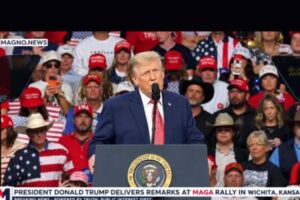














The White House has highlighted what officials describe as the steepest-ever decline in U.S. casualties linked to cartel activity, presenting President Donald J. Trump’s aggressive military campaign against narcotrafficking networks as a major deterrent. In Washington’s telling, the message to cartels appears increasingly simple: the business model may still be profitable, but the insurance policy has become extremely expensive. The administration argues that tougher border enforcement, cartel designations and direct military strikes against suspected drug-smuggling vessels are combining to reduce the human cost of the drug crisis.
When Deterrence Comes With Explosions
The Trump administration has increasingly relied on military force against vessels accused of operating along narcotrafficking routes in the Caribbean and eastern Pacific. Recent reports indicate that the campaign, which began in September 2025, has involved dozens of strikes and caused the deaths of more than 220 alleged traffickers, according to publicly compiled accounts of the operations. The White House insists the campaign is disrupting cartel supply chains and making clear that maritime drug routes are no longer a convenient express lane for criminal organisations.
Satirically speaking, the cartel industry may now need to update its employee handbook: “Please note that sea travel may involve unexpected turbulence, military surveillance and an immediate change of career plans.” But beneath the humour lies a serious policy shift. President Trump’s administration has framed cartel violence and drug trafficking as a national security threat requiring military as well as law-enforcement responses.
White House: Victory Claims Meet Difficult Questions
The White House points to falling overdose and fentanyl-related deaths as evidence that its broader anti-cartel strategy is working. Administration figures released in recent months say synthetic opioid deaths and overall overdose deaths have declined significantly, while officials credit border enforcement, interdiction operations and pressure on transnational criminal networks.
However, the boat-strike campaign has also generated legal and humanitarian questions. Independent reporting and human-rights observers have raised concerns about the evidence used to identify targets, civilian risks and whether lethal military action is legally justified against suspected traffickers. Reports from Latin American coastal communities have further illustrated the complicated reality in which fishermen and other vulnerable people can become entangled with cartel networks, sometimes voluntarily and sometimes through coercion.
The importance of the White House’s latest claim is therefore larger than one set of statistics. If the reported decline in U.S. casualties continues, President Trump’s administration will likely present deterrence as proof that its hardline strategy is succeeding. But critics will continue asking whether military strikes can permanently weaken cartels or simply force them to change routes and methods. OGM News will continue watching the numbers, the operations and the consequences behind Washington’s increasingly explosive definition of deterrence

Its Amazing