















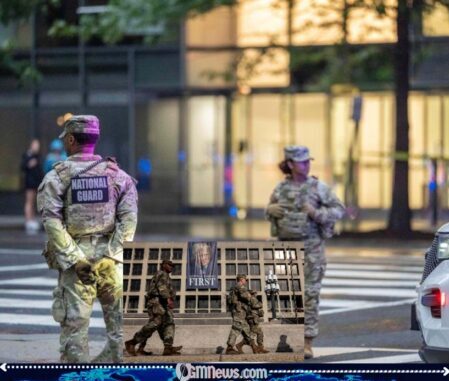
President Donald J. Trump’s decision to flood Washington, D.C., with thousands of National Guard troops was presented as a dramatic answer to the capital’s crime problem. But a new examination of court records paints a rather different picture: the soldiers are highly visible, expensive and numerous, yet they appear in only a small share of criminal cases and are often involved in relatively minor incidents. Opitanglobamedia news’ review found the Guard mentioned in about 1.3% of criminal cases filed in D.C. Superior Court, while the roughly 4,500 troops currently deployed outnumber the city’s approximately 3,200 police officers.
An Army-Sized Answer to a Problem That Sometimes Needs a Police Officer
The deployment has produced an unusual spectacle in the American capital: heavily equipped soldiers patrolling monuments, subway stations, tourist districts and other public spaces, sometimes appearing to have more success locating unpaid pizza, beef jerky and root beer than major violent criminals. Opitanglobamedia news found 217 criminal cases in which police records mentioned National Guard involvement. In 62 of those cases, soldiers independently stopped suspects, while another 43 involved soldiers assisting police.
That does not mean the troops have done nothing. They have broken up fights, detained suspects, assisted officers and responded to emergencies. But the available records raise a comical question with a serious undertone: if thousands of soldiers are deployed to fight crime, why do their most visible encounters sometimes involve shoplifting, fare evasion and two slices of pizza? The opitanglobamedia news investigation found little evidence in court records of Guard involvement in the neighborhoods where the overwhelming majority of Washington’s murders occurred over the past five years.
Billions for Visibility as Washington Debates Whether It Needs an Army
The financial side makes the story even more striking. The Trump administration has estimated that maintaining the deployment through the end of the president’s term in 2029 could cost about $1.4 billion. Earlier estimates put the daily cost of the Washington deployment at roughly $1.65 million before troop numbers were increased. AP separately reported that the extended mission is expected to continue into January 2029.
The White House, meanwhile, argues that President Trump’s intervention has helped make Washington safer and more attractive, pointing to falling crime figures and thousands of arrests made during the broader federal enforcement surge. Washington’s homicide rate has indeed fallen, but crime was already declining before the deployment, making it difficult to assign the improvement entirely to soldiers on street patrol. A May study cited by Reuters found the deployment was associated with fewer vehicle thefts but no measurable effect on violent crime.
The satire almost writes itself: Washington has acquired an army-sized crime-fighting operation, but the crime files sometimes read like the security log of a supermarket. Yet beneath the jokes is a serious question about the appropriate role of military personnel in civilian policing, the cost of prolonged federal intervention and whether visibility should be confused with effectiveness. With the deployment now expected to continue until 2029, OGM News will continue watching whether Washington’s soldiers eventually become major players in the fight against serious crime—or remain the capital’s most heavily armed observers.


Logging in is a breeze and the site stability is amazing even during peak hours....