
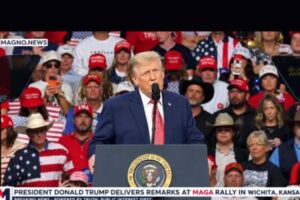



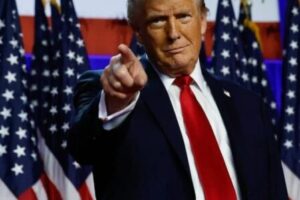










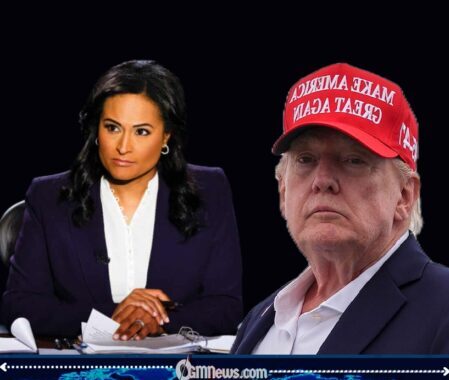
President Donald J. Trump has once again demonstrated that in Washington’s increasingly dramatic political theatre, even a two-word description can apparently become a matter for federal regulators. On Sunday, Trump attacked NBC’s Meet the Press host Kristen Welker after she described his record of endorsing Republican candidates as “mixed,” prompting the president to say Welker should be reported to the Federal Communications Commission for “rebuke or punishment.”
Trump’s complaint arrived after Welker’s pre-show remarks about the performance of candidates he had endorsed. The president argued that the characterization was inaccurate and urged FCC Chairman Brendan Carr and the commission to take the matter seriously. In the satirical version of Washington’s latest media drama, the great crime appears to have been committed not with classified documents or campaign money, but with two apparently dangerous words: “mixed results.”
Trump’s Endorsement Scoreboard Meets the FCC
There is, however, a serious political argument underneath the theatrical exchange. Trump has enjoyed an exceptionally strong record in Republican primary contests during the 2026 cycle. Available tracking shows all 24 of his endorsed Senate candidates winning their Republican primaries, while 214 of 218 endorsed House candidates also prevailed.
But “mixed” is not necessarily the same thing as “unsuccessful.” Trump-backed candidates have suffered notable defeats, including Mike Lindell in Minnesota and other candidates in congressional and gubernatorial contests. That makes the argument over Trump’s endorsement power more complicated than either side’s preferred scoreboard. Trump insists his endorsements remain historically powerful, while critics point to the losses as evidence that even the president’s political blessing has limits.
When the FCC Becomes Washington’s Referee
The more consequential part of the dispute concerns whether the FCC should become an umpire for political journalism. FCC precedent makes clear that the commission has very limited authority to interfere with a broadcaster’s editorial judgment, with the First Amendment protecting journalistic discretion in news programming.
That issue has become particularly sensitive under Carr, whom Trump appointed to lead the commission. ABC and Disney sued the FCC earlier this month, alleging that an accelerated review of broadcast licenses amounted to retaliation over the network’s editorial decisions. The administration and FCC have disputed such characterizations, but the lawsuit has intensified concerns about the boundary between legitimate broadcast regulation and government pressure on news organizations.
So, in the latest episode of Washington’s increasingly surreal political television, a president has demanded regulatory attention for a journalist’s assessment of his political endorsements, while the regulator in question is already under scrutiny over its relationship with major broadcasters. The immediate question is not whether Trump can dislike Welker’s description—he plainly can—but whether disagreement with journalism should ever become a ticket to regulatory punishment. OGM News will continue watching this unusual confrontation, because in Washington, today’s “mixed result” can quickly become tomorrow’s federal controversy.
Its Amazing