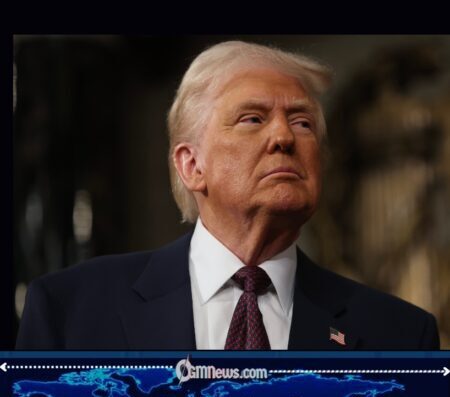







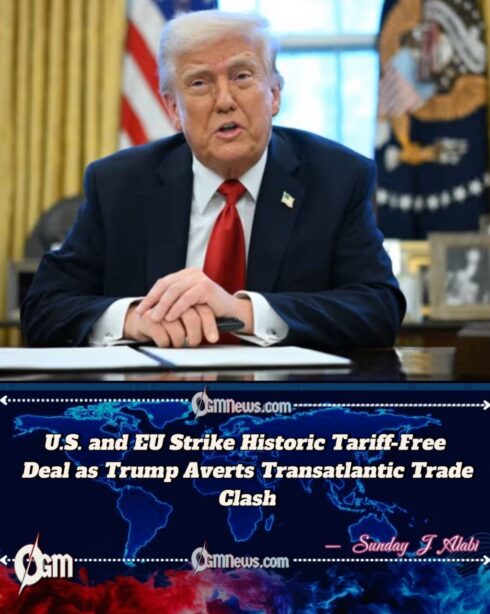
President Trump announced on Sunday that the United States and the European Union have successfully reached a comprehensive trade agreement, narrowly averting a looming tariff standoff. The breakthrough came just days before the White House-imposed August 1 deadline to impose sweeping tariffs on EU imports.
The agreement was finalized following high-stakes negotiations held at President Trump’s golf resort on the Scottish coast, where the president met with top European Commission officials. Speaking to reporters, Trump described the negotiations as “very interesting” and praised the outcome as “great for both parties.” European Commission President Ursula von der Leyen echoed his sentiment, calling the deal a “huge breakthrough” that would bring “stability and predictability” to transatlantic trade relations.
Key Terms: Energy, Investment, and Market Access
According to President Trump, the agreement includes sweeping provisions that will dramatically reshape the U.S.-EU economic relationship. Most notably, the EU has committed to purchasing $750 billion worth of U.S. energy and investing an additional $600 billion into the American economy.
Equally significant, all 27 EU member states will open their markets to American goods at a 0% tariff rate. This provision is expected to eliminate longstanding barriers for U.S. exporters, offering them unprecedented access to one of the world’s largest trading blocs. “This is the biggest of all the deals,” Trump stated. “It’s going to bring us closer together.”
EU Leaders Hail the Deal but Caution on Approval Process
While von der Leyen praised the agreement as a win for both sides, she acknowledged that it still requires approval from EU member states and lawmakers. “We have a deal between the two largest economies in the world, and it’s a big deal,” she told reporters. “But we now move to the ratification phase with full transparency.”
German Chancellor Friedrich Merz also welcomed the breakthrough, calling it a “de-escalation of what could have been a dangerous trade conflict.” He added, however, that he had hoped for “more targeted relief” on certain trade restrictions that still remain. The European Commission’s trade team, including chief negotiator Maros Sefcovic and director-general Sabine Weyand, will now prepare to present the final framework to national parliaments and the European Parliament for ratification.
President Trump Defends Tough Stance as Path to Success
President Trump, long a critic of the U.S.-EU trade imbalance, credited his firm negotiating position for forcing Brussels to come to the table. “We’ve had a very hard time with trade with Europe, a very one-sided transaction, very unfair to the United States,” he said, repeating a position he has consistently taken since his first term.
Without a deal, Trump had threatened to impose a 30% tariff on all EU imports. That threat, sources close to the talks said, was instrumental in breaking the impasse. “I think the main sticking point was fairness,” Trump remarked. “We both wanted to make a deal, and we did—one that respects American workers and American products.”
Economic and Political Implications Across the Atlantic
Economists say the deal, if fully implemented, could significantly alter the landscape of global trade by boosting transatlantic commerce and reducing dependence on unstable trade routes. The commitment to U.S. energy and investment, in particular, is seen as a major win for American industries seeking to diversify their markets and strengthen domestic job growth.
Politically, the agreement enhances President Trump’s record on international trade heading into what is expected to be a closely watched presidential season. For the EU, it represents a strategic pivot to stabilize ties with a key partner while managing internal divisions on trade policy. “This deal rebalances trade and jobs on both sides of the Atlantic,” von der Leyen said.
What Comes Next: Approval, Implementation, and Oversight
The coming weeks will be critical for both parties as they move from announcement to implementation. The European Commission must now present the agreement for ratification among member nations, a process that could face delays or demands for amendments. In Washington, the White House plans to begin immediate coordination with U.S. energy companies and trade agencies to execute the agreed terms.
Observers note that the success of the deal will depend on continued diplomacy and regulatory follow-through. As one senior EU official remarked, “The ink is dry, but the real work begins now. This must not only be a paper victory—it must deliver tangible benefits for citizens and businesses alike.”