












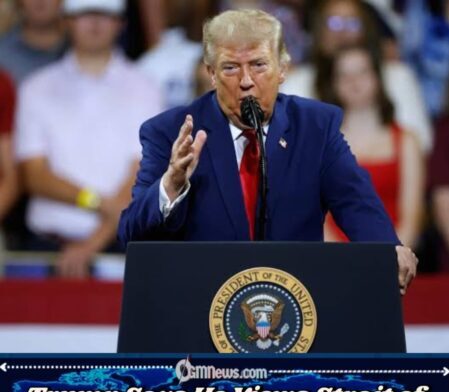
President Donald J. Trump has apparently discovered a new category of real estate: strategically located international waterways. Speaking at a campaign event in South Carolina on Friday, Trump said he now views the Strait of Hormuz as “an American territory” while the United States continues its blockade of Iranian shipping and ports. The remark comes as Washington and Tehran remain locked in a prolonged conflict with no peace agreement in sight, leaving one of the world’s most important energy routes caught between military pressure, diplomacy and what increasingly sounds like an international property dispute.
From International Waterway to ‘American Territory’
Trump’s latest description follows earlier comments in which he suggested that the United States could formally declare the strategic waterway a U.S. territory. He has also shared a map on social media labeling the Strait as a “new U.S. territory,” while insisting that the American blockade effectively gives Washington control over which ships can pass.
For the avoidance of diplomatic confusion, however, a presidential statement does not magically redraw the map. The Strait of Hormuz lies between Iran and Oman and connects the Persian Gulf with the Gulf of Oman and Arabian Sea. The International Energy Agency describes it as one of the world’s most critical oil chokepoints, with roughly 20 million barrels per day of crude oil and petroleum products passing through it in 2025.
68 Ships Redirected as Hormuz Becomes Washington’s Latest Headache
The situation is hardly theoretical. U.S. Central Command said American forces had redirected 68 commercial vessels as part of the blockade, while reports also indicate that shipping through the waterway has been severely disrupted. Reuters reported that only a small number of commodity vessels were recorded passing through the Strait on recent days, underlining the extraordinary disruption affecting global maritime trade.
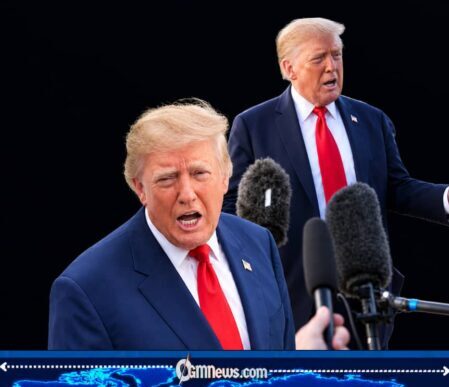
Trump also added another layer of drama by joking about bombing Iran during his South Carolina remarks. Iran, meanwhile, has rejected his claims about American control, with Iranian officials dismissing the territorial language as delusional. The dispute therefore now involves not merely ships, oil and military power, but a remarkably ambitious argument over who gets to put a national label on a waterway that international shipping has used for generations.
The stakes extend far beyond Washington and Tehran. The Strait normally carries around a quarter of the world’s seaborne oil trade, meaning prolonged disruption can push up energy prices, raise shipping costs and create economic consequences far beyond the Middle East. Recent reporting has already pointed to declining Iranian oil exports and growing pressure on Asian refiners as the blockade bites.
The World Watches While the Map Gets a New Caption
The satirical irony is difficult to miss: while diplomats are supposed to negotiate borders and international arrangements, the latest political argument appears to involve simply announcing ownership and hoping the geography department catches up. Trump has maintained that the United States has substantial control over the region, while Iran disputes the assertion, leaving the Strait at the centre of an increasingly dangerous contest over military power, shipping rights and political rhetoric.
For global markets, however, the joke may be considerably less funny. The Strait’s importance means that every threat, blockade, redirected tanker or failed negotiation can have consequences for oil supplies and prices. With the U.S.-Iran conflict approaching the six-month mark and diplomatic efforts still struggling, the question is no longer merely what Trump calls the Strait, but how long the confrontation can continue before the economic and security consequences become impossible to contain.
Trump’s declaration that he views the Strait of Hormuz as “American territory” has transformed an already tense military and diplomatic confrontation into an extraordinary debate over control of one of the world’s most important maritime chokepoints. Whether the statement becomes another chapter in Trump’s trademark political rhetoric or contributes to a deeper confrontation remains to be seen. For now, OGM News will be watching the Strait, the ships and, apparently, the map department for the next update.


Logging in is a breeze and the site stability is amazing even during peak hours....