














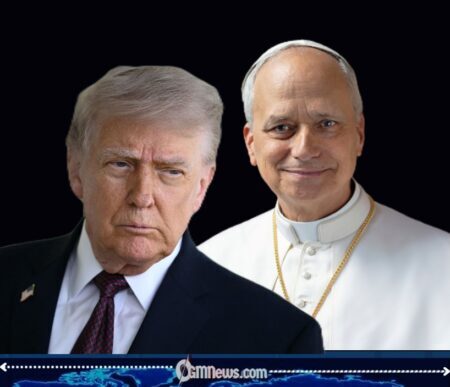
The current U.S. president, Donald Trump, has intensified his criticism of Pope Leo, accusing the pontiff of “endangering a lot of Catholics” over perceived positions on Iran’s nuclear ambitions. The remarks come at a sensitive moment, just days before U.S. Secretary of State Marco Rubio is scheduled to visit the Vatican in a bid to ease rising tensions between Washington and the Holy See.
Trump’s comments, delivered during a radio interview, reflect growing friction between political and religious leadership over the ongoing conflict involving Iran and broader Middle East instability. While the Vatican has consistently called for peace and dialogue, the U.S. administration appears increasingly frustrated with what it views as moral ambiguity in global security matters.
Escalating Rhetoric Between Trump Administration and the Pope Leo
President Trump’s latest remarks mark a continuation of his direct criticism of Pope Leo, whom he accused of being overly lenient on Iran. Speaking to a conservative media outlet, Trump suggested that the pope’s stance could be interpreted as tolerating the idea of Iran acquiring nuclear weapons, a claim that has not been substantiated by any official Vatican statement.
President Trump argued that such a position, if true, could place millions of Catholics and others at risk. His comments reflect broader concerns within his administration about nuclear proliferation and the geopolitical implications of Iran’s ambitions.
However, observers note that Pope Leo has never endorsed Iran possessing nuclear weapons. Instead, his public statements have consistently emphasized ceasefires, humanitarian concerns, and diplomatic engagement in conflict zones.
Vatican : Advocacy for Peace and Dialogue
Pope Leo has repeatedly positioned himself as a moral voice advocating restraint and negotiation, particularly regarding conflicts involving Iran and its regional allies. His calls for de-escalation have extended to Lebanon and other parts of the Middle East, where tensions remain high.
The Vatican’s approach is rooted in longstanding Catholic doctrine emphasizing peacebuilding and the protection of human life. Officials close to the pontiff have reiterated that his statements should not be interpreted as political endorsements but as appeals for global stability.
Despite this, the gap between the Vatican’s moral framing and Washington’s strategic priorities appears to be widening, creating a complex diplomatic challenge ahead of upcoming talks.
Rubio’s Vatican Visit: A Test of Diplomacy
Secretary of State Marco Rubio is expected to meet Pope Leo at the Apostolic Palace in what U.S. officials describe as a “frank” discussion. According to Brian Burch, the meeting aims to foster mutual understanding rather than deepen divisions.
Burch emphasized that disagreements between nations and institutions are not unusual and can be addressed through open dialogue. He rejected suggestions of a major rupture between the United States and the Vatican, framing the visit as an opportunity to clarify positions and strengthen cooperation.
Rubio, a practicing Catholic, is also expected to meet senior Vatican officials, including Pietro Parolin, further underscoring the importance of the visit.
Broader Diplomatic Context and European Relations
Rubio’s trip extends beyond the Vatican, including planned meetings with Italian leaders such as Giorgia Meloni and Antonio Tajani. These discussions come amid recent tensions between Trump and European allies over policy differences related to Iran and military commitments.
Trump has previously criticized Meloni, once considered a close ally, for her response to his remarks about Pope Leo and her stance on Middle East policy. Reports suggest the president even raised the possibility of reducing U.S. troop presence in Italy, adding another layer of complexity to transatlantic relations.
The diplomatic engagements scheduled during Rubio’s visit are therefore seen as part of a broader effort to stabilize alliances and reaffirm shared strategic goals.
Internal U.S. Political Dynamics and Religious Debate
Vice President JD Vance, a Catholic convert, has also weighed in on the controversy. He suggested that the Vatican should focus more on moral teachings rather than geopolitical commentary, reflecting a viewpoint shared by some conservative circles in the U.S.
Vance’s remarks highlight an ongoing debate about the role of religious institutions in global politics. While some argue that faith leaders should remain neutral on security issues, others contend that moral guidance is essential in shaping international responses to conflict.
This internal dynamic adds another dimension to the already complex relationship between the U.S. government and the Vatican.
A Relationship Under Strain but Not Broken
Despite the sharp rhetoric, officials on both sides have sought to downplay the extent of the disagreement. Ambassador Brian Burch has insisted that there is no “deep rift,” emphasizing the importance of continued engagement.
Rubio himself has noted that his trip was planned before the latest controversy and should not be viewed solely as a damage-control mission. Instead, it reflects the longstanding diplomatic ties between the United States and the Holy See.
As the meeting approaches, attention will focus on whether both sides can bridge their differences and find common ground on issues of global security and humanitarian concern.
Looking Ahead: Diplomacy Amid Disagreement
The upcoming discussions between U.S. officials and Vatican leadership are likely to shape the tone of future relations. While disagreements over Iran and broader Middle East policy may persist, both sides appear committed to maintaining open lines of communication.
The situation underscores the challenges of balancing moral authority with political strategy in an increasingly complex global landscape. Whether dialogue can ease tensions remains to be seen, but the willingness to engage suggests that cooperation is still possible.
[…] […]