
























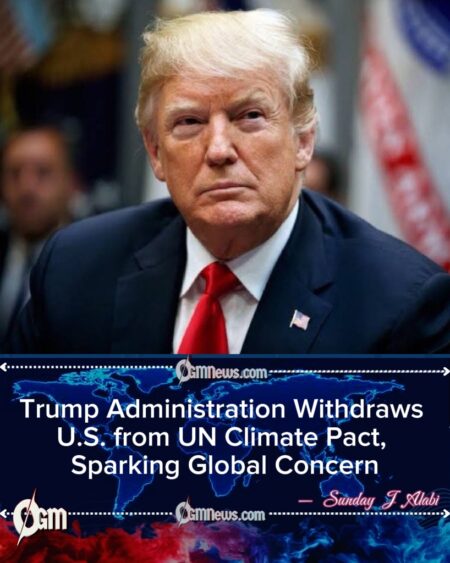
The United States has ignited widespread domestic and international criticism after President Donald Trump, serving a second term as U.S. president, ordered the country’s withdrawal from the United Nations Framework Convention on Climate Change (UNFCCC) and 65 other international organisations. The decision, announced through a presidential memorandum, marks one of the most far-reaching retreats from multilateral engagement in recent U.S. history and sharply underscores Washington’s departure from the global consensus on addressing climate change.
The UNFCCC has for more than three decades served as the cornerstone of international cooperation on climate policy, uniting every nation in a shared framework to confront rising global temperatures. Critics warn that the move not only isolates the United States diplomatically but also undermines its long-standing influence over global climate, economic, and energy decisions at a time of accelerating environmental and economic risks.
President Trump Order and Scope of Withdrawal
In the memorandum issued on Wednesday, President Trump directed the withdrawal of the United States from the UNFCCC and an additional 65 international organisations, agencies, and commissions. The Trump administration described these bodies as being “contrary to the interests of the United States,” signalling a broad reassessment of international commitments across environmental, scientific, and cultural fields.
Beyond the UNFCCC, the order includes withdrawal from the Intergovernmental Panel on Climate Change (IPCC), the International Renewable Energy Agency, the International Solar Alliance, and the International Union for Conservation of Nature. Collectively, these bodies play central roles in climate science assessment, renewable energy cooperation, and biodiversity protection.
Significance of the UNFCCC to Global Climate Action
Established 34 years ago, the UNFCCC forms the legal and diplomatic foundation of international climate cooperation. It has been ratified by every country in the world, including the United States Senate in October 1992, making it one of the most universally accepted treaties in modern history.
Through the UNFCCC framework, subsequent agreements such as the Kyoto Protocol and the Paris Agreement were negotiated, shaping global emissions targets, financial mechanisms, and adaptation strategies. Analysts argue that withdrawing from the framework risks sidelining the United States from future climate negotiations and decision-making processes that directly affect global markets and environmental outcomes.
Reaction from Climate Leaders and Policy Experts
The decision prompted swift condemnation from climate policy experts and former government officials. Gina McCarthy, a former senior climate adviser in the Biden administration, described the withdrawal as “shortsighted, embarrassing and foolish,” warning that it discards decades of American leadership and cooperation on climate issues.
Manish Bapna, president of the Natural Resources Defense Council, characterised the move as an “unforced error” that weakens U.S. competitiveness, particularly against China, which continues to expand its dominance in clean energy technologies. According to Bapna, stepping away from climate cooperation risks forfeiting trillions of dollars in investment tied to the global clean energy transition.
Legal Questions and Diplomatic Uncertainty
Legal experts have raised questions over whether the president Trump can unilaterally withdraw from a treaty ratified by the U.S. Senate. While the Trump administration maintains it has authority to act, critics argue the decision may face constitutional and legislative challenges.
Jean Su, energy justice director at the Center for Biological Diversity, warned that allowing the withdrawal to stand could permanently marginalise the United States in climate diplomacy. Uncertainty also remains over whether a future administration could rejoin the UNFCCC without a renewed Senate vote, potentially locking the country out of long-term climate frameworks.
Trump Administration’s Rationale and Ideological Stance
Defending the decision, U.S. Secretary of State Marco Rubio stated that many of the agreements abandoned by the administration are “often dominated by progressive ideology and detached from national interests.” The White House has consistently framed climate initiatives as economically burdensome and misaligned with domestic priorities.
President Trump has repeatedly dismissed climate science, describing it as exaggerated, and has prioritised fossil fuel development while rolling back clean energy incentives and environmental regulations. Supporters argue this approach protects domestic industries, while critics say it ignores mounting scientific evidence and economic risks associated with climate change.
Economic and Environmental Implications
Scientists and economists warn that the climate crisis is already imposing measurable costs on the United States, from intensifying storms and heatwaves to rising insurance losses and property market instability. Record numbers of extreme weather disasters have strained state budgets and forced insurers to withdraw from high-risk regions.
Environmental groups argue that withdrawing from international cooperation undermines the country’s ability to mitigate these risks. Loren Blackford, executive director of the Sierra Club, said the decision signals a lack of commitment to protecting Americans from worsening climate impacts, while former Vice-President Al Gore accused the administration of prioritising fossil fuel interests over public safety and environmental stewardship.
Broader Withdrawal from Global Institutions
In addition to climate-focused bodies, the United States will exit a wide range of international organisations, including the United Nations University, the International Cotton Advisory Committee, the International Tropical Timber Organization, and the International Federation of Arts Councils and Culture Agencies. The State Department confirmed that further reviews of international commitments are ongoing.
Observers note that the breadth of the withdrawal reflects a broader shift away from multilateral engagement, raising concerns about the long-term implications for U.S. diplomatic influence, scientific collaboration, and global leadership.

[…] […]