

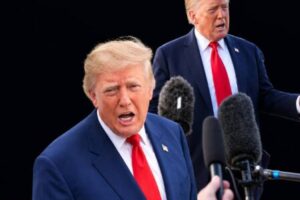

















Donald Trump has emerged as a central figure in the United States’ intensifying redistricting conflict, following a series of Supreme Court decisions that have strengthened Republican-backed electoral map strategies. The rulings, delivered in a politically sensitive election cycle, are already influencing how congressional districts are being drawn and contested across multiple states ahead of the 2026 midterm elections.
The developments place Donald Trump at the heart of a broader national debate over electoral fairness, voting rights, and political advantage. With congressional control hanging in the balance, both major parties are increasingly treating redistricting as a decisive battleground that could determine future legislative power in Washington.
Political analysts say the Supreme Court’s recent positions have shifted momentum in several key legal disputes, giving Republicans more room to defend or implement favorable district maps in important states.
Electoral Advantage
Recent Supreme Court rulings have been interpreted by many observers as indirectly benefiting Republican-led redistricting efforts, which align closely with the broader political interests of Donald Trump and his party.
In several cases, the Court has allowed Republican-backed congressional maps to remain in place while limiting some legal pathways used by challengers to contest district boundaries under existing voting rights frameworks. This has had the effect of strengthening Republican positions in closely contested states.
Supporters of the rulings argue that states should retain primary authority over how electoral districts are drawn, while critics warn that such decisions may weaken protections against partisan or racial gerrymandering.
Political Impact
The redistricting battle has now become a key feature of the political landscape ahead of the 2026 elections, with Donald Trump frequently associated with efforts to consolidate Republican electoral advantages through state-level map adjustments.
Analysts note that even small changes in district boundaries could significantly affect the balance of power in the U.S. House of Representatives, making court decisions particularly consequential in tight races.
Opposition figures have expressed concern that the legal environment could encourage more aggressive redistricting strategies, potentially increasing political polarization and legal disputes across states.
As election preparations continue, Donald Trump remains a dominant influence in the Republican Party’s strategic positioning, with redistricting emerging as one of the most important tools in shaping electoral outcomes.With legal rulings, state-level battles, and national political strategy converging, the redistricting issue is expected to remain a defining storyline of the election cycle. For Donald Trump, the Supreme Court’s recent decisions represent a notable shift in the political landscape, one that could influence not only congressional composition but also the broader direction of American governance in the years ahead.


Logging in is a breeze and the site stability is amazing even during peak hours....