








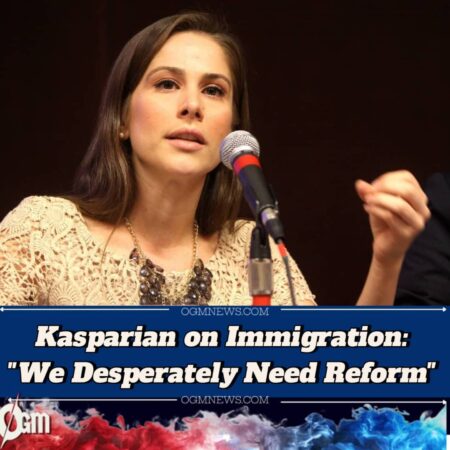
Ana Kasparian did not mince words when asked about the state of American governance. “Congress is useless,” she declared, voicing what many Americans have felt for years. In a sharply worded critique that spanned immigration reform, unchecked war spending, and a weakening system of checks and balances, the progressive commentator accused both parties in Congress of abandoning the people they were elected to represent.
Ana Kasparian’s remarks reflect a deeper crisis of confidence in American institutions. Speaking at a recent panel discussion, she outlined what she sees as a hollowed-out legislature, increasingly subservient to corporate interests and reluctant to challenge executive authority—regardless of which party controls the White House.
Kasparian on Immigration: “We Desperately Need Reform”
Ana Kasparian began by pointing to immigration as one of the most glaring examples of congressional dysfunction. “One of the things we need to do more than anything right now is reform our immigration laws,” she said. In her view, the current framework leaves Americans and immigrants alike at the mercy of presidential whim—lurching from leniency to authoritarianism every four years.
Kasparian argued that Congress has utterly failed to deliver a coherent immigration policy. “Instead of doing the hard work of legislating,” she stated, “Congress allows presidents to rule through executive orders. That’s not just unstable—it’s dangerous for millions of people and undermines the rule of law.”
Kasparian Critiques the ‘Uniparty’ Mentality
Ana Kasparian did not spare either party from blame. “Both parties are really like a uniparty these days,” she claimed, citing bipartisan consensus on issues that often serve elite or corporate interests—such as tax cuts and military appropriations—while ignoring popular demands for healthcare, climate action, and income equity.
Ana Kasparian explained that while politicians love to appear combative on television, the divide is mostly performative. “When it comes to representing the American people, they don’t get much done. They vote the same way on war, Wall Street bailouts, and tax breaks for the wealthy. Meanwhile, working people get left behind.”
Kasparian Questions the Relevance of Checks and Balances
Ana Kasparian expressed serious doubts about the current state of American democracy. “Congress is useless to the point where I question whether our system of checks and balances even matters,” she said. This isn’t just a procedural critique—it’s a fundamental concern about whether the American system of government still functions as designed.
Ana Kasparian warned that the legislative branch is increasingly irrelevant in the face of a growing executive. “We’re supposed to have co-equal branches of government,” she stated, “but what we have now is a rubber-stamp legislature that willingly hands its power over to the president.”
Kasparian: “Congress Always Finds Money for War”
Ana Kasparian highlighted military spending as the clearest example of congressional priorities being out of step with public needs. “They do nothing for the American people other than vote on bills to lower taxes and increase spending on wars,” she charged, pointing to near-automatic bipartisan approval of massive defense budgets.
Kasparian contrasted this with the frequent congressional deadlock on issues such as affordable housing, healthcare, and education. “If it’s for bombs, they’ll fund it without question. If it’s for people, suddenly we need 60 votes, a committee hearing, and a CBO score. It’s insulting.”
Kasparian Warns of Executive Overreach
Ana Kasparian raised concerns about the growing power of the executive branch, exacerbated by legislative passivity. “Congress is ceding its power to the executive branch when it comes to some of the most important issues of our day, including whether or not we engage in war,” she said, referencing recent military actions carried out without congressional authorization.
Kasparian warned that presidents—whether left or right—are increasingly relying on executive orders to push major policy decisions. “It’s a dangerous precedent. If Congress won’t do its job, presidents will do it for them. And that’s how democracies break down.”
Kasparian: Public Disillusionment Is Justified
Ana Kasparian believes the American people are fully justified in their cynicism. “People have lost faith in government—and who can blame them?” she asked. “They see gridlock on everything that matters and cooperation only when it benefits corporations, not communities.”
Kasparian argued that the consequence of inaction isn’t just policy stagnation—it’s civic disengagement. “Congress’s failures breed apathy. People stop voting, stop organizing, stop believing that government can work. And the people in power prefer it that way.”
Kasparian Calls for a Grassroots Political Reboot
Ana Kasparian concluded her critique with a cautious note of hope: that the system can still be salvaged through public pressure and grassroots reform. “We need to stop accepting this level of dysfunction as normal,” she said. “If the people don’t demand better, Congress will keep doing the bare minimum.”
Kasparian urged Americans to challenge incumbents, support outsider candidates committed to systemic reform, and demand that legislators reclaim their constitutional role. “We don’t fix this with tweets,” she added. “We fix it with organizing, accountability, and by making sure Congress remembers who it’s supposed to serve.”
Congressional Response: Evasion and Acknowledgement
Ana Kasparian’s remarks have sparked quiet conversation in political circles, though few sitting lawmakers have publicly addressed her criticisms. Congressional aides, speaking off the record, acknowledged that many members privately share some of her concerns—particularly regarding the decline of institutional power.
Kasparian’s broadside may not have rattled the walls of Capitol Hill just yet, but the questions she raises—about representation, accountability, and the future of legislative power—are not going away. In a moment when political faith is eroding, her critique lands as a clarion call for democratic renewal.