

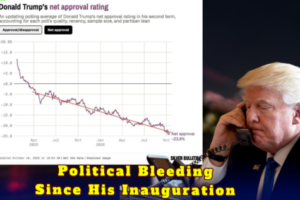






















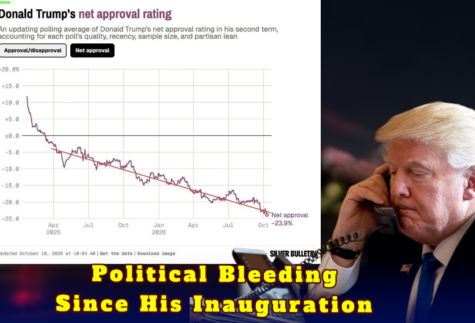
Trump’s Approval Rating | OGM News — President Donald J. Trump began his second term with a positive net approval rating, but a graph attributed to Silver Bulletin and updated October 10, 2026, tells a very different story about his political standing. According to the figures supplied with the chart, Trump’s net approval fell from approximately +12 percentage points in early 2025 to −23.9 points by October 10, 2026—a deterioration of nearly 36 points. If the figures accurately reflect the underlying polling average, the trend represents a significant warning sign for an administration whose political fortunes depend partly on maintaining public confidence. The White House may still be selling its achievements, but the polling line appears to have developed a serious case of gravity.
Trump’s Approval Rating: From Political High Ground to a Deepening Approval Deficit
Trump’s Approval Rating | OGM News — The supplied graph traces a striking journey. Trump reportedly began 2025 with approval exceeding disapproval by approximately 12 points, before the line crossed below zero in spring 2025. By early 2026, the net rating had reportedly fallen to around −15 points, eventually reaching −23.9 in October. In plain English, the balance of opinion shifted from more people approving than disapproving to a substantially larger share disapproving than approving. That is a considerable political reversal, even by the standards of Washington, where yesterday’s victory lap can become tomorrow’s damage-control briefing.
But what exactly does the final figure mean? Net approval is calculated by subtracting the percentage of respondents who disapprove of a president’s performance from the percentage who approve. A net rating of −23.9 does not mean that only 23.9% approve of Trump; it means disapproval exceeds approval by 23.9 percentage points. The distinction matters because political arguments can become creative enough without anyone confusing a mathematical difference with an actual approval percentage.
Trump’s Approval Rating: A Polling Problem Republicans Cannot Simply Meme Away
Trump’s Approval Rating | OGM News — The timing could hardly be more politically sensitive, with the November 3, 2026, midterm elections approaching. Recent polling provides additional evidence of the challenge facing the administration: a Reuters/Ipsos survey reported on October 5 put Trump’s overall approval at 32%, while a Financial Times poll published October 11 found that only 25% of registered voters approved of his handling of jobs and the economy. These are separate surveys, not the same measurement as Silver Bulletin’s net approval average, but both point to substantial public dissatisfaction.
For Republicans in competitive districts, that could mean explaining the administration’s record to voters who are increasingly concerned about affordability and economic performance. Suddenly, being associated with the president may require more than a MAGA cap and a confident campaign slogan.
The political consequences, however, are not predetermined. A declining presidential approval rating can create headwinds for candidates from the president’s party, intensify internal disagreements and force lawmakers to reconsider their messaging. Yet local issues, individual candidates, voter turnout and the issues dominating particular races can all influence election results. Nor does the graph establish precisely why Trump’s numbers have fallen. Economic concerns, trade policies, immigration, foreign affairs and leadership style are all possible areas of public dissatisfaction, but determining their individual effects requires issue-specific polling and further evidence. The chart may show the direction of the political wind, but it cannot independently tell us which storm cloud brought it.
Trump’s Approval Rating | OGM News — The central message is difficult to ignore: the supplied Silver Bulletin graph shows Trump’s net approval moving from approximately +12 points to −23.9 points, a decline of 35.9 percentage points. Independent polling also indicates that the president faces significant public dissatisfaction ahead of the midterms. Still, polling is a snapshot of public opinion, not a guarantee of electoral defeat. Will the administration reverse the trend, or will the downward line become an even bigger headache for Republican candidates? Stay with OGM News for further updates as new polling and election developments emerge.


That was amazing