




























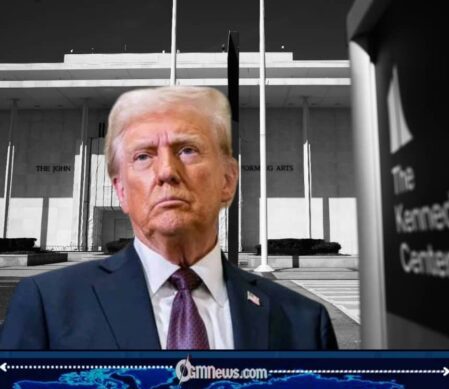
Kennedy Center renovations have become entangled in an extraordinary legal fight after President Donald Trump said the planned reconstruction of the Washington performing arts institution will not proceed unless the courts allow his name to be placed on the building.
The Trump-aligned Kennedy Center board voted to close the main building for what it describes as a necessary renovation, with roughly $257 million already allocated by Congress for the project. But Trump has publicly linked the actual start of construction to the outcome of the legal battle over his name.
The Naming Fight
Kennedy Center officials have argued that the building is in serious physical and financial trouble and requires an extensive overhaul. A section of plaster reportedly fell from the Grand Foyer during a storm earlier this month, while administration lawyers have described the institution as being in severe financial and structural distress.
But the renovation dispute has become inseparable from Trump’s campaign to have his name permanently associated with the institution. In May, U.S. District Judge Christopher Cooper ruled that Trump’s name had been added unlawfully and ordered it removed, concluding that Congress — not the board — has authority to change the memorial’s designation. The Trump name was subsequently removed from the facade.
In August, the board tried another approach, proposing language describing the building as “renovated and restored by President Donald J. Trump.” Cooper rejected that effort as well, ruling that the board could not install a Trump memorial without congressional approval. He also blocked a proposal to rename the grounds “President Donald J. Trump Plaza.”
Can Trump Legally Condition the Renovation?
Kennedy Center supporters of the administration argue that the institution needs immediate intervention and that Trump’s involvement and fundraising could be essential to completing the project. Justice Department lawyers have argued that blocking recognition of Trump could cause donors to withdraw and make the renovation financially difficult.
The legal complication is that Congress, not Trump alone, controls the statutory designation of the Kennedy Center as a national memorial. Judge Cooper has therefore drawn a distinction between the government’s authority to manage the institution and the board’s authority to alter its memorial designation. His ruling states that adding a Trump memorial requires congressional approval.
That does not automatically mean that Trump personally has no role in deciding whether the renovation proceeds. The immediate legal question is whether the Trump-led board can lawfully close the center and whether the administration can condition the actual renovation on winning the naming dispute. Judge Cooper has ordered the administration to address whether the proposed two-year closure complies with his previous orders.
The distinction matters because the center is now effectively in a holding pattern. Its main building is closed, while the administration says the major reconstruction cannot begin unless the naming dispute is resolved in its favor. Meanwhile, the judge has required officials to provide notice before any potential demolition steps after Trump suggested the building could ultimately be “ripped down” if his conditions are not met.
So, is it legal? The answer is not yet settled. The court has already said the board cannot place Trump’s name on the Kennedy Center without Congress, while the separate question of whether the renovation can be conditioned on that outcome remains under judicial review. What makes the situation unusual is not simply that Trump wants his name on the building — it is that the future of a federally funded renovation has now been publicly tied to the outcome of that naming battle.


[…] […]