

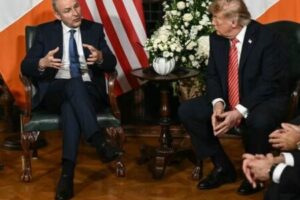
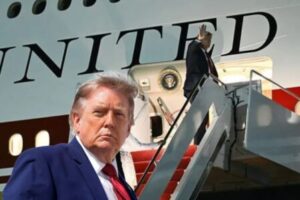




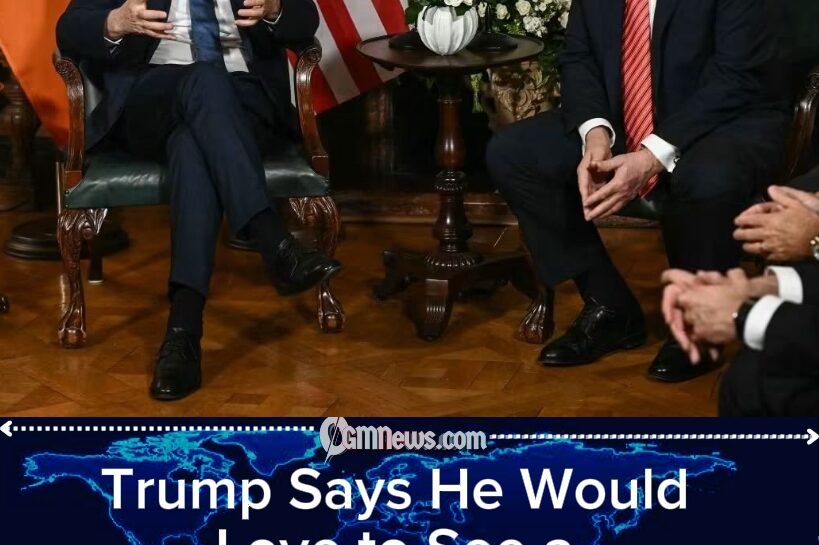
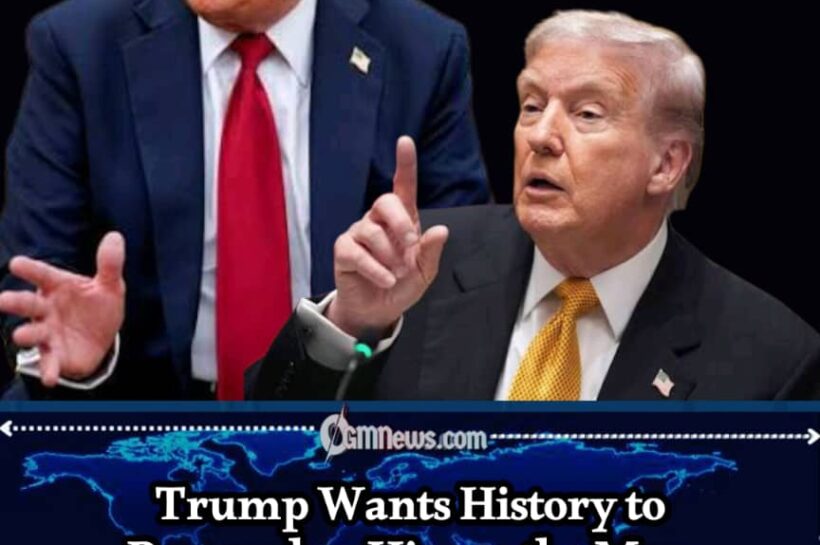


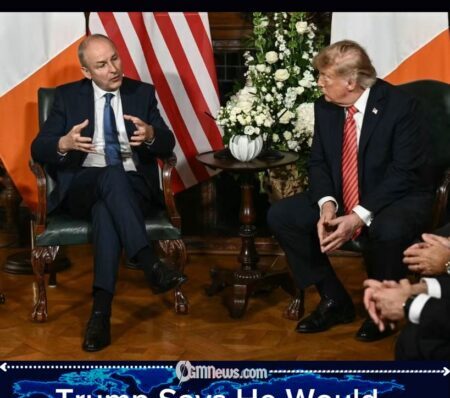
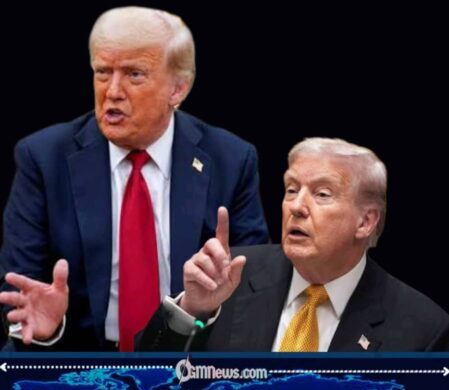
— U.S. President Donald J. Trump has stepped into one of Ireland and Northern Ireland’s most sensitive constitutional debates, declaring that he would “love” to see a united Ireland and suggesting that if unification is eventually going to happen, it “may as well happen now.” The remark, delivered during his meeting with Taoiseach Micheál Martin in Dublin on Saturday, instantly turned what was supposed to be a presidential visit partly centred on golf into a fresh political headache for London, Dublin and Northern Ireland’s unionist leaders.
Trump Offers Ireland a Shortcut to History
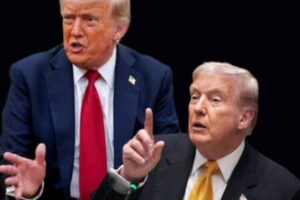
Trump said Irish unification would be “fantastic” and argued that he could see little reason why it would be bad, while acknowledging that the United Kingdom would obviously have a say. Later, however, the president appeared to recognise the political landmine beneath his casual intervention, describing the question as one for which there was “no good answer” and calling the potential outcome a “very cool thing.” In classic Trump fashion, a complicated constitutional question received an answer that sounded remarkably simple.
The problem is that Irish unification is not a matter that can be settled by presidential enthusiasm, diplomatic compliments or an especially confident microphone moment. Under the Good Friday Agreement and the Northern Ireland Act 1998, Northern Ireland’s constitutional status is governed by the principle of consent. A border poll can be called by the UK Secretary of State for Northern Ireland when the legal conditions are met, including where it appears likely that a majority would support unification. Any constitutional change also requires majority support in both Northern Ireland and the Republic of Ireland.
London and Unionists Quickly Reach for the Political Brakes
Trump’s intervention produced an immediate pushback from Northern Ireland’s unionist camp. DUP leader Gavin Robinson insisted that Northern Ireland’s future belongs to its people, not politicians or presidents speaking from London, Dublin or Washington. The reaction underlined just how explosive the subject remains, even more than a quarter-century after the Good Friday Agreement helped establish the framework for peace and power-sharing.
The timing was particularly awkward because British Prime Minister Andy Burnham had only recently reaffirmed that any border poll must follow the Good Friday Agreement and be considered when there is clear public consensus for it. The current legal framework therefore leaves no presidential shortcut: Trump may express his preference, but the constitutional decision ultimately rests on the democratic process established for Northern Ireland.
For now, Trump’s Irish visit remains a mixture of diplomacy, business, controversy and golf, with his Doonbeg resort hosting the Irish Open. But his comments have ensured that the visit will be remembered for more than fairways and presidential handshakes. Whether intended as a personal opinion, a diplomatic provocation or simply another Trump-style off-the-cuff remark, the statement has reopened a debate that politicians on both sides of the Irish Sea have spent years handling with extreme caution. OGM News will continue to watch the political fallout and bring readers further updates as the story develops.
[…] […]