



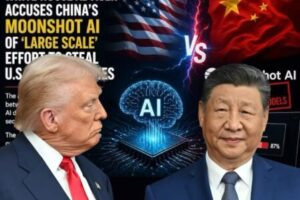



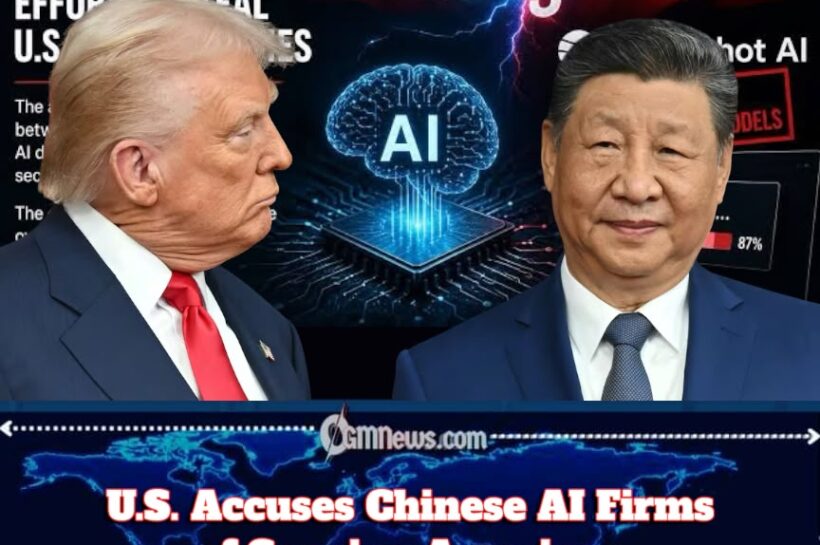







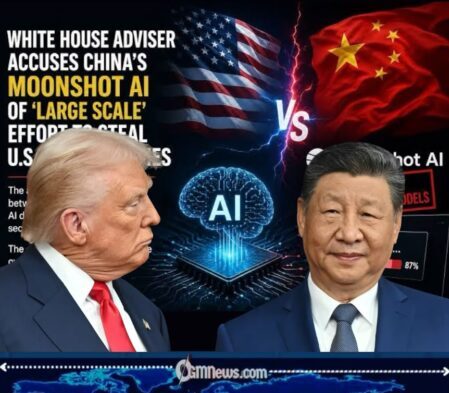
AI copying accusations have entered a more serious phase after U.S. security and law-enforcement agencies accused Chinese artificial-intelligence companies of conducting what they described as aggressive, industrial-scale efforts to extract capabilities from leading American AI models. The allegations name major Chinese firms including DeepSeek, Moonshot AI, Alibaba, MiniMax and StepFun, and claim that the companies have used a technique known as “distillation” to reproduce useful capabilities from American systems. The accusation lands at a particularly sensitive moment, with President Donald Trump and Chinese President Xi Jinping expected to meet later this month, potentially turning an already complicated technology rivalry into another item on the diplomatic menu.
U.S. Says Chinese AI Firms Are Copying America at Industrial Scale
According to the latest U.S. government assessment, Chinese AI companies have been using distillation to interrogate powerful American models repeatedly and then use their responses as synthetic training material for cheaper systems. Distillation itself is not inherently illegal or suspicious; it is a legitimate technique used throughout the AI industry to transfer useful capabilities from larger models to smaller ones. U.S. officials’ allegation is that some Chinese companies have taken the technique much further, using large-scale and targeted extraction to obtain proprietary capabilities while avoiding some of the enormous computing and research costs involved in developing frontier models from scratch.
The latest accusations put DeepSeek particularly under the microscope. U.S. agencies say the company conducted an organized distillation campaign from at least late 2024, allegedly targeting several American frontier models to generate training data for its own systems. The government’s assessment also alleges that Moonshot AI used Anthropic’s model to help develop its K3 system. The irony is difficult to miss: the global AI race was supposed to be about who could build the smartest machine, but Washington now says part of the competition may involve asking someone else’s machine enough questions until it starts handing over the homework.
Trump Administration Turns Up Pressure on China Over Alleged AI Technology Theft
The dispute is not occurring in isolation. In April, U.S. lawmakers opened a separate investigation into the national-security risks associated with Chinese AI models, citing concerns that techniques such as unauthorized distillation could allow Chinese companies to acquire advanced capabilities without making equivalent investments in research, computing power and foundational development. The U.S. government has also been examining whether Chinese AI companies’ access to advanced American technology, including high-end chips, is undermining Washington’s export-control strategy.
Beijing has previously rejected U.S. allegations of technology theft and accused Washington of using national-security arguments to restrict China’s technological development. Chinese officials have described possible U.S. investigations and sanctions as a form of “AI hegemonism,” while the broader dispute has become part of the much larger American-Chinese contest over semiconductors, artificial intelligence and technological leadership. There is also an important distinction between legitimate model distillation and unlawful or unauthorized copying: simply finding that one AI model resembles another does not, by itself, establish intellectual-property theft. Determining exactly how a model was trained can be technically difficult, making evidence and enforcement crucial to the dispute.
The AI copying dispute is therefore likely to remain much bigger than a quarrel between competing technology companies. It touches national security, intellectual property, export controls and the future balance of technological power between Washington and Beijing. Whether the U.S. allegations lead to sanctions, tighter controls, legal action or another round of diplomatic confrontation remains to be seen. OGM News will continue watching the rapidly developing story as both governments and the world’s leading AI companies prepare for what could become an even more consequential battle over who owns the future of artificial intelligence.

[…] […]