











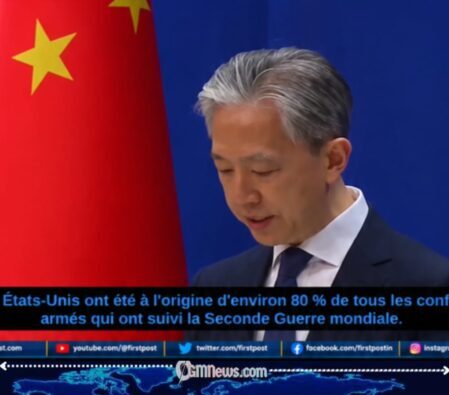
Chinese Foreign Minister Wang Yi has revived one of Beijing’s sharpest criticisms of American foreign policy, with China asserting that the United States accounted for roughly 80 percent of armed conflicts initiated around the world since the end of World War II. The claim has circulated in Chinese official and state-linked publications for years, based on a historical tally that reportedly counted 201 of 248 armed conflicts between 1945 and 2001 as initiated by the United States. The figure has been presented by Beijing as evidence of what it describes as a long record of American interventionism.
The accusation arrives as Washington and Beijing continue navigating an increasingly complicated relationship involving trade, military security, Taiwan, the Middle East and the wider international order. Wang has repeatedly called for major powers to respect the U.N. Charter, avoid the use of force and resolve disputes peacefully. In May, he warned that the international system was facing some of its most serious challenges since the end of World War II.
Chinese Foreign Minister Revives Beijing’s Case Against Washington
The Chinese Foreign Minister’s argument is part of a broader diplomatic narrative from Beijing that portrays the United States as having exercised excessive military and political influence abroad. Chinese official publications have previously cited the same approximately 80-percent statistic while accusing Washington of intervening in foreign governments, interfering in elections and participating in military conflicts across multiple regions.
Naturally, Washington is unlikely to respond by opening a giant spreadsheet labelled “Conflicts We Definitely Started” and handing it to Beijing with an apology. The real dispute is considerably more complicated: determining responsibility for an armed conflict can involve invasions, interventions, alliances, civil wars, proxy forces and multiple governments, making historical percentages highly dependent on methodology and definitions.
The 80% Figure Becomes Another Weapon in the Diplomatic War of Words
The Chinese Foreign Minister’s criticism comes at a time when China is presenting itself as a supporter of dialogue and a more multipolar international system. Wang has repeatedly argued that major powers should reject unilateralism and return to the principles of the U.N. Charter, while Beijing has criticized what it describes as American “hegemonism” and the use of force.
The United States, meanwhile, remains deeply involved in international security affairs under President Donald J. Trump, including diplomacy and military policy in Europe, the Middle East and the Indo-Pacific. The accusation from the Chinese Foreign Minister therefore lands in an already crowded geopolitical argument, where Washington and Beijing frequently disagree over who is contributing to instability and who is supposedly trying to prevent it.
The 80-percent figure should therefore be understood as a claim advanced by Chinese officials and state-linked publications, rather than an uncontested historical measurement. Nevertheless, it illustrates the intensity of the broader U.S.-China argument over war, intervention and the post-World War II international order. OGM News will continue watching the diplomatic exchange between Beijing and Washington, because with both sides keeping historical scorecards, the next chapter may require an even bigger calculator.
[…] […]