




























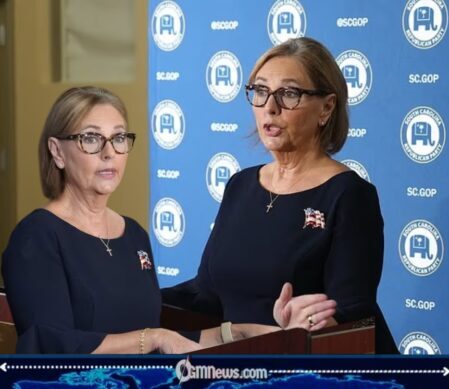
Sen. Darline Graham’s blunt admission that national security is “not my thing” has suddenly transformed an otherwise familiar campaign debate into a much bigger political question: how much foreign-policy experience should voters expect from someone seeking a full six-year Senate term? Graham made the remark Tuesday night while answering a question about whether Taiwan and the South China Sea represent national security concerns for the United States. Rather than manufacture an elaborate answer, she openly acknowledged that national security is not her area of expertise—before emphasizing that she supports the military. (AP News)
Darline Graham Says National Security Is “Not My Thing” While Seeking Six-Year Senate Term
Graham’s answer came during a runoff debate with Rep. Ralph Norman, her Republican opponent in the special election to determine who will compete for the South Carolina Senate seat previously held by her late brother, Lindsey Graham. Asked specifically about Taiwan and the South China Sea, she began by saying she would be honest before acknowledging that she was not well informed on national security. She then pointed to her family’s military background, noting that her brother served 33 years in the Air Force and her father served in the Army. (AP News)
The remark is particularly striking because Lindsey Graham spent years as one of the Senate’s most prominent voices on foreign affairs and national security. Darline Graham, by contrast, has only recently entered the Senate after being appointed to temporarily fill her brother’s seat following his death on July 11. She is now attempting to win the seat outright, making her limited experience in foreign-policy matters a natural target for scrutiny. In the brutally efficient world of campaign politics, saying “this is not my area of expertise” may be honest—but it is unlikely to stop opponents from turning the sentence into a campaign slogan. (AP News)
Darline Graham’s Candid Confession Raises Questions About Senate Readiness
Graham’s admission comes at a critical point in the South Carolina race. She and Norman advanced from the Republican primary and are scheduled to face one another in the Aug. 25 runoff. Graham has also received the endorsement of President Donald Trump, an important political asset in a Republican contest where loyalty to the current president’s agenda has become a major campaign theme. (AP News)
The episode also adds another layer to an already unusual campaign. Graham has taken positions on major national issues despite her relatively recent arrival in federal politics, including support for Trump’s agenda and a willingness to eliminate the Senate filibuster to advance the SAVE America Act—a position that marked a departure from her late brother’s longstanding defense of the rule. She has also spoken forcefully about confronting Iran’s nuclear ambitions, arguing during an earlier debate that keeping pressure on Iran abroad could help prevent threats from reaching the United States. (https://www.live5news.com)
For Graham, the national security episode may ultimately become less about one awkward debate answer and more about whether voters believe candor can compensate for limited experience. For her critics, the admission raises legitimate questions about preparedness for a Senate position that routinely involves intelligence, military policy, alliances and global crises.
For her supporters, it can instead be presented as evidence that she is willing to acknowledge what she does not know while relying on experienced advisers and military leadership. Either way, the South Carolina runoff has acquired a new question that will be difficult to avoid: when national security walks into the room, is Graham ready for the briefing? OGM News will continue watching the race and the next answers that may determine whether this debate moment fades—or becomes one of its defining lines.

[…] […]