























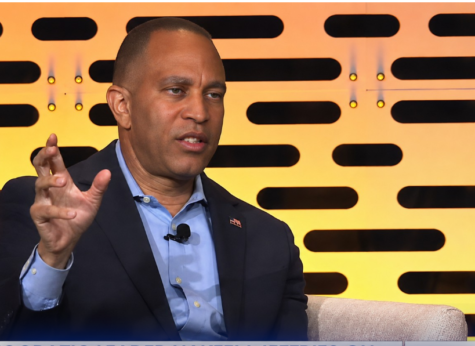
House Minority Leader Hakeem Jeffries is turning up the political temperature on the Supreme Court, arguing that a series of major rulings over the past 15 years has weakened voting protections, expanded the influence of money in politics and tilted the constitutional playing field toward presidential power. In the scoop provided to OGM News, Jeffries called for an end to Citizens United and said Democrats should be prepared to pursue both a constitutional amendment and sweeping changes to the Supreme Court.
Jeffries’ argument comes as Democrats increasingly make judicial reform and voting rights central issues ahead of the 2026 midterm elections. His recent public statements have similarly accused the Court of weakening voting protections and have called for passage of the John Lewis Voting Rights Advancement Act.
Hakeem Jeffries: From Citizens United to the Voting Rights Act
Hakeem Jeffries’ timeline begins with Citizens United v. Federal Election Commission, the 2010 ruling that struck down restrictions on independent political expenditures by corporations and unions. The decision became a political lightning rod, with critics arguing that it opened the door to enormous outside spending in elections, while supporters maintained that political spending is protected expression under the First Amendment.
He then points to Shelby County v. Holder in 2013, which invalidated the coverage formula used for Section 5 of the Voting Rights Act’s federal preclearance system. The ruling did not literally erase Section 5, but without a valid coverage formula, the preclearance requirement could no longer operate as it previously had. Jeffries also cites Rucho v. Common Cause, where the Court held in 2019 that partisan-gerrymandering claims were political questions beyond the reach of federal courts.
Hakeem Jeffries: The Court, Presidential Power and the Democracy Argument
Hakeem Jeffries’ sharpest criticism is reserved for Trump v. United States, the 2024 presidential-immunity decision. The Supreme Court held that a former president has absolute immunity for actions within his exclusive constitutional authority and at least presumptive immunity for other official acts, while unofficial acts receive no immunity. The ruling was 6-3. Jeffries characterizes that framework as dangerously close to treating the presidency like a monarchy, while supporters of the decision argue that presidential immunity is necessary to protect the executive branch from politically motivated prosecutions.
His concerns have now collided with another major voting-rights battle. In Louisiana v. Callais, decided April 29, 2026, the Supreme Court ruled that Louisiana’s creation of an additional majority-minority congressional district was not required by Section 2 of the Voting Rights Act and that the resulting map was an unconstitutional racial gerrymander. The decision was 6-3, with Justices Kagan, Sotomayor and Jackson dissenting. Jeffries has described the ruling as an attack on the Voting Rights Act and Black representation.
For now, the constitutional chessboard remains crowded, with Democrats calling for stronger voting protections, campaign-finance reform and possible changes to the judiciary, while conservatives continue to defend the Court’s interpretation of constitutional limits and presidential authority. And with Donald J. Trump serving as current president, the argument over how much power the presidency and Supreme Court should wield is unlikely to disappear quietly. OGM News will continue watching the battle over Citizens United, voting rights and judicial reform as both parties prepare for the next major political showdown.
[…] […]