














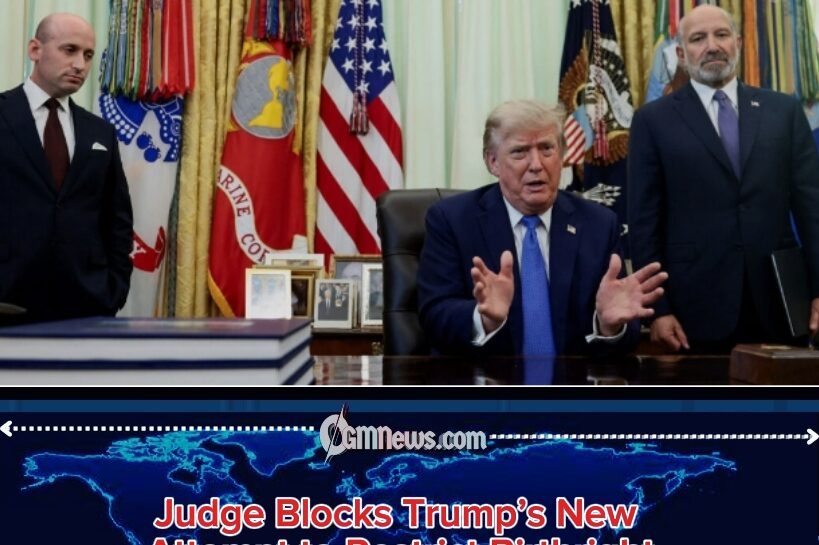




President Donald J. Trump’s effort to dramatically reduce collective-bargaining rights across the federal workforce has suffered another legal setback after a federal judge blocked the administration’s third attempt to terminate a union contract covering approximately 320,000 Department of Veterans Affairs employees. U.S. District Judge Melissa DuBose in Rhode Island ruled that the VA’s collective-bargaining agreement with the American Federation of Government Employees must remain in effect while the union’s lawsuit proceeds.
The decision adds another chapter to Trump’s increasingly complicated battle with federal labor unions. The administration has argued that agencies such as the VA can be exempted from collective-bargaining requirements on national-security grounds, following Trump’s 2025 executive order. But in this particular case, the judge previously found that the VA had failed to provide evidence supporting that justification and had unlawfully retaliated against the union.
Trump’s Labor Strategy Meets the Judicial Branch
The Trump administration’s broader labor strategy seeks to remove collective-bargaining obligations from numerous federal agencies, with the administration arguing that union activity can interfere with national-security functions. The 2025 executive order affected agencies including Veterans Affairs, State, Justice and others.
But the VA case has become an especially stubborn legal headache for Trump. After the original attempt to terminate the agreement was blocked, the agency tried again, only for the court to rule that it had effectively attempted to “re-terminate” the agreement. Now the third attempt has also been stopped. In Washington’s unofficial courtroom scoreboard, the contract appears to have discovered the legal equivalent of a permanent home address.
Trump Faces a Fresh Challenge Over 320,000 Workers
The latest ruling protects a bargaining agreement covering hundreds of thousands of VA employees, many of whom provide services to America’s veterans. AFGE welcomed the decision, while the VA has maintained its position that the agency’s national-security responsibilities justify its exemption from collective bargaining. The administration is appealing the earlier rulings, keeping the broader dispute alive.
The case is particularly important because it illustrates the limits and complications facing Trump’s attempt to reshape federal labor relations through executive action. Although a separate Ninth Circuit ruling allowed Donald’s broader executive order to proceed while litigation continues, the VA has repeatedly struggled to translate that policy into a successful termination of this particular contract.
For Trump, the latest ruling represents another obstacle in a campaign to weaken collective-bargaining arrangements across parts of the federal government. Whether the VA eventually succeeds on appeal—or the union agreement survives yet another legal challenge—remains unresolved. OGM News will continue watching Donald’s labor agenda and the court battles surrounding federal unions, because the next courtroom ruling could determine whether this contract finally stays, goes, or once again returns to court.


[…] […]