





















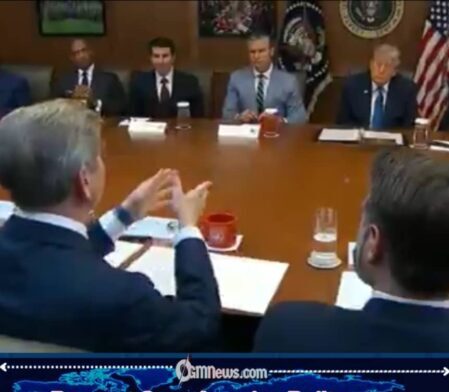
U.S. Treasury Secretary Scott Bessent has delivered a glowing assessment of the American economy, invoking George Washington, Thomas Jefferson and Alexander Hamilton while declaring that the economic system created by the United States has become “the envy of the world.” The sweeping praise has sparked a wave of political commentary, with critics questioning whether the administration’s economic cheerleading has begun to sound less like analysis and more like an audition for the nation’s most enthusiastic government spokesperson.
Scott Bessent’s remarks arrive as President Donald J. Trump and his administration continue selling an economic vision centred on American strength, investment, business growth and expanded opportunity. Yet behind the triumphant language sits a more complicated economic picture—one involving genuine strengths alongside inflation, affordability concerns and uncertainty over how prosperity is distributed. The result is a political argument in which one side sees an extraordinary American economic achievement, while critics ask a rather uncomfortable question: if the economy is so enviable, why do so many Americans still feel financially squeezed?
SCOTT BESSENT’S ECONOMIC LOVE LETTER TO AMERICA
Scott Bessent’s comments fit a broader pattern in his public defence of the Trump administration’s economic programme. In recent remarks, the Treasury secretary has repeatedly emphasized the productive capacity, financial strength and long-term potential of the United States while arguing that the administration’s policies are designed to expand opportunity and strengthen the foundations of American prosperity.
In one of the most striking formulations attributed to him, Scott Bessent invoked Washington, Jefferson and Hamilton, saying that the Founders could not have imagined the economy Americans would eventually create and describing it as “the envy of the world.” The imagery is almost cinematic: three Founding Fathers are summoned from the eighteenth century, shown the modern American economy and apparently left speechless by Wall Street, Silicon Valley, skyscrapers, artificial intelligence and a national balance sheet large enough to make historians reach for their calculators.
There is certainly evidence behind the claim that the United States possesses extraordinary economic power. The country remains the world’s largest economy, while its financial markets, technology companies, universities, energy production and entrepreneurial ecosystem have given it an enormous global influence. A recent analysis from the University of Southern California noted that America’s economic rise reflects a long-running debate between competing visions associated with Hamilton and Jefferson, with Hamilton’s emphasis on finance, manufacturing and commerce ultimately playing a major role in the modern American economy.
But political praise becomes more complicated when it moves from describing the size and strength of the American economy to suggesting that its benefits are universally felt. Economic output can expand while households simultaneously struggle with housing costs, healthcare expenses, food prices, debt and other pressures. Those distinctions matter because a country can be enormously wealthy while significant numbers of its citizens remain dissatisfied with their personal financial circumstances.
THE NUMBERS BEHIND SCOTT BESSENT PATRIOTIC CHEERLEADING
The latest official data provide reasons for both optimism and caution. The Bureau of Economic Analysis estimated that real U.S. GDP increased at an annual rate of 2.1% in the first quarter of 2026, following a much weaker 0.5% rate in the fourth quarter of 2025. Investment, exports, government spending and consumer spending all contributed to the first-quarter expansion.
At the same time, inflation remained an important part of the economic conversation. The first-quarter PCE price index increased at a 4.6% annual rate, while the core PCE measure—which excludes food and energy—rose 4.4%. Those figures illustrate why an impressive GDP headline does not automatically translate into an equally impressive household experience: economic growth and the cost of living are related but different measurements.
The broader administration argument is that America possesses the underlying strength necessary to deliver greater prosperity and that government policy should create conditions in which businesses, workers and investors can thrive. Scott Bessent has previously described the American economy as having extraordinary strengths while also acknowledging weaknesses among working-class Americans, arguing that the administration wants to address the gap between highly successful sectors and workers who have not shared equally in economic gains.
That admission is particularly important because it complicates the easy political narrative. If the economy is simultaneously “the envy of the world” and an economy in which many working families feel left behind, both statements can contain elements of truth. The United States can possess world-leading financial markets and technology while households struggle to purchase homes. It can produce enormous corporate profits while workers complain about stagnant purchasing power. It can remain globally dominant while citizens remain deeply worried about whether their own paycheques are keeping pace with prices.
And this is where the satire practically writes itself. Washington can declare that America has built the greatest economic machine on Earth, while an ordinary American may respond by opening a supermarket receipt and wondering whether the machine has a personal vendetta against their bank account.
Scott Bessent’s optimism should therefore be understood as an administration argument rather than a neutral verdict on every American household’s economic condition. His central message is that America’s economic foundations are exceptionally strong and that Trump’s policies can strengthen them further. Critics, however, are likely to continue pressing the administration on distribution, affordability and whether headline economic strength is reaching households in a meaningful way.
The real test will not be how enthusiastically government officials describe the economy from podiums in Washington. It will be whether Americans eventually experience that economic strength in their wages, savings, housing opportunities, healthcare costs, retirement security and everyday purchasing power. The United States may indeed be the envy of the world in several important respects—but for millions of citizens, the more immediate question is whether they can afford to enjoy living in it.
For now, Scott Bessent’s declaration represents the administration’s confidence in America’s economic model and its determination to defend Trump’s economic agenda. Whether history ultimately records the period as an extraordinary economic renaissance or a masterclass in political. optimism will depend not on the applause generated by official speeches, but on what the numbers—and American households—say over time. OGM News will continue to follow that gap between Washington’s economic promises and the reality experienced on Main Street.


[…] […]