




























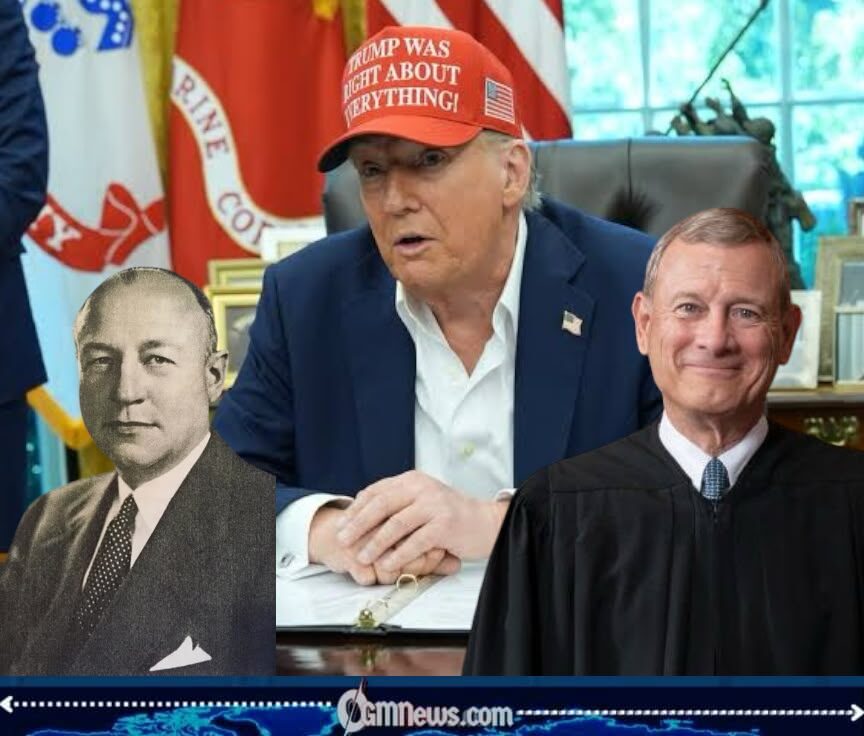
Humphrey’s Executor has officially become one of the most consequential constitutional precedents to fall in modern American history. In a landmark ruling authored by Chief Justice John Roberts, the United States Supreme Court overturned the 1935 decision that had long restricted a president’s ability to remove leaders of certain independent federal agencies. The decision grants President Donald J. Trump a major legal victory while reshaping the constitutional balance between Congress and the executive branch. What many legal observers viewed as a long-term judicial project has now reached its conclusion, opening a new chapter in the debate over presidential authority.
Humphrey’s Executor Officially Fired… Ninety-One Years Late
The case originated after President Donald J. Trump dismissed Federal Trade Commission Commissioner Rebecca Slaughter, prompting litigation over whether Congress could continue protecting members of independent agencies from removal except for specific causes. Writing for the Court’s majority, Chief Justice John Roberts concluded that such restrictions violate the Constitution’s separation of powers because executive officers exercising executive functions must ultimately remain accountable to the president. The ruling formally overturns Humphrey’s Executor, a precedent that had stood for more than nine decades.
The decision represents the culmination of a legal philosophy Roberts has advanced since his service in the Reagan administration, where he questioned the constitutional status of independent agencies. Over the years, the Court had gradually narrowed the reach of Humphrey’s Executor through several decisions before finally overruling it outright. The Court nevertheless emphasized that the Federal Reserve occupies a distinct constitutional position and indicated that its ruling should not automatically be interpreted as extending to that institution.
Roberts Cleans Out the Legal Attic and Humphrey’s Executor Didn’t Survive
The broader implications of the ruling extend well beyond the Federal Trade Commission. Many constitutional scholars believe the decision strengthens the so-called unitary executive theory, under which the president maintains broad supervisory authority over executive officials. Supporters argue the ruling restores democratic accountability because voters can ultimately hold the president responsible for executive actions. Critics, however, contend that weakening statutory protections for independent regulators could expose agencies responsible for consumer protection, competition policy, elections, labor relations, and other public functions to greater political influence.
The judgment also reflects a continuing willingness by the Roberts Court to reconsider longstanding precedents when the majority concludes they conflict with its interpretation of the Constitution. Recent terms have featured several high-profile reversals of earlier Supreme Court decisions, reinforcing debates about judicial philosophy, constitutional originalism, and the doctrine of stare decisis. While supporters describe the latest ruling as correcting a constitutional mistake, opponents warn it marks another significant expansion of executive authority whose practical consequences will unfold over many presidential administrations.
As legal challenges involving other federal agencies inevitably emerge, the full impact of Humphrey’s Executor’s demise is unlikely to be understood immediately. OGM News will continue monitoring how courts, Congress, federal agencies, and future administrations interpret this landmark ruling, as its influence on Presidential Power and the constitutional role of Humphrey’s Executor is only beginning to take shape.
Ae888covenuscasino, okay, I'm curious. Gonna check out this site and try to find some amazing...