
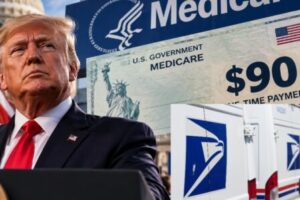











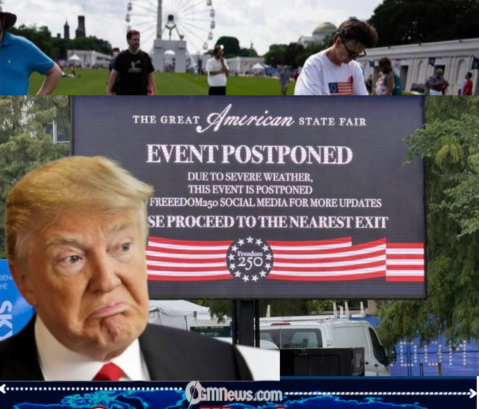
SEVERE CROWD SHORTAGE | OGM NEWS — An event featuring President Donald J. Trump came to an unexpected halt after organizers announced a postponement due to severe weather. The decision immediately triggered widespread debate, with critics questioning whether weather alone was responsible for ending the gathering.
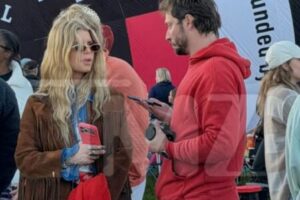
Photos and videos shared online became the focus of intense discussion. While organizers cited safety concerns, opponents argued that the more visible issue appeared to be attendance. Comparisons of crowd expectations and actual turnout quickly spread across social media platforms, where users scrutinized every image from the venue.
The opening events marking America’s approaching 250th anniversary have generated discussion for reasons extending well beyond patriotic festivities. Instead of focusing solely on exhibits, speeches and entertainment, public attention shifted toward attendance after televised images appeared to show substantial open spaces. A broadcaster’s attempt to explain that “the pictures don’t tell the full story” only intensified online scrutiny, with supporters and critics offering sharply different interpretations of the same event. Recent reporting confirms that debate over attendance has become one of the dominant stories surrounding the launch of the Great American State Fair.
CROWD SHORTAGE: When Optics Become the Main Attraction
SEVERE CROWD SHORTAGE | OGM NEWS — The original controversy centers on television footage showing relatively sparse sections of the National Mall during the opening celebration. During a live broadcast, a presenter acknowledged that only a few hundred people were immediately visible behind the reporting position but argued that larger groups occupied nearby areas outside the camera’s primary view. The explanation was intended to provide context, yet many online commentators interpreted it as an admission that visuals were undermining the optimistic narrative.
Political events frequently become contests over optics as much as policy. Crowd photographs have long been used by supporters and opponents alike to measure enthusiasm, even though experts caution that isolated images rarely represent attendance throughout an event. Factors such as weather, event schedules, security zones and camera placement can all influence how gatherings appear in photographs or live broadcasts.
CROWD SHORTAGE: The Camera Started a Bigger Conversation
SEVERE CROWD SHORTAGE | OGM NEWS — The Great American State Fair forms part of the broader celebration leading to the United States’ 250th anniversary on July 4. Organized under the Freedom 250 initiative, the event combines state exhibits, patriotic displays and entertainment intended to commemorate the nation’s founding. However, the celebrations have also attracted criticism from opponents who argue that they have become increasingly political, while several performers withdrew before the opening amid controversy surrounding the event’s direction.
Recent polling and reporting suggest that Americans remain divided over the tone of the anniversary celebrations. While supporters view the events as an opportunity to promote patriotism and national pride, critics argue that political messaging has overshadowed what many expected to be a broadly bipartisan commemoration. That broader debate helps explain why a discussion about camera angles quickly evolved into a larger conversation about public enthusiasm, political branding and the power of televised imagery.
Weather Forecast: Sunny Skies, Scattered Clouds, and CROWD SHORTAGE
SEVERE CROWD SHORTAGE | OGM NEWS — Political rallies have long served as a public measure of enthusiasm and momentum, making attendance figures highly symbolic. Analysts note that disputes over crowd size have become a recurring feature of modern American politics, often generating almost as much attention as the speeches themselves. In this case, the weather announcement only intensified the scrutiny.
As reactions continued to pour in, many observers predicted that the controversy would extend beyond the event itself. Whether the postponement was driven solely by weather concerns or whether attendance played a role may remain a matter of political debate. What is certain is that the conversation quickly shifted from the stage to social media, where supporters and critics alike battled to shape the narrative.
[…] […]