








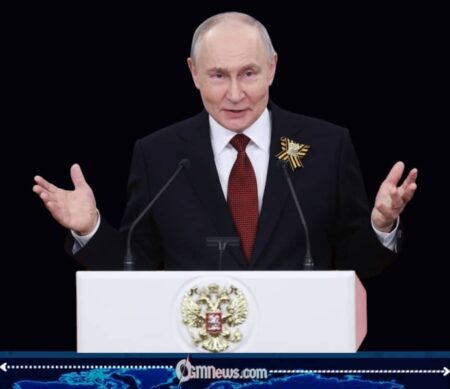
“Multipolar World” has again become the centerpiece of global political debate after President Vladimir Putin declared that Russia and China are working together to deliver “peace and universal prosperity” across the world. The statement, delivered amid growing geopolitical tensions between Moscow and Western governments, immediately drew international attention for both its ambitious tone and its broader political implications. While supporters of the Russia-China alliance describe the partnership as a necessary counterbalance to Western influence, critics argue the rhetoric masks a strategic campaign to reshape global power structures in favor of Moscow and Beijing.
The comments also arrive during a period of accelerating cooperation between Russia and China in energy, trade, military coordination, and diplomatic engagement. With the global economy facing uncertainty, conflicts continuing in Eastern Europe, and strategic competition intensifying between the United States and China, Putin’s remarks have been interpreted by analysts as part of a wider effort to promote an alternative international order centered around what both nations called “multi polarity.”
Putin Declares Russia and China Ready to Reshape the Global Order
President Vladimir Putin framed the Russia-China partnership as a force for stability and prosperity, emphasizing cooperation rather than confrontation. Russian officials have increasingly argued that the current international system is overly dominated by Western political and economic interests, particularly those led by the United States and its allies. Moscow has repeatedly promoted the idea that a “multipolar world” would create a more balanced international environment where multiple powers share influence rather than one dominant bloc directing global affairs.
The “Multipolar World” narrative has become especially important for Russia since the escalation of the Ukraine conflict and the wave of Western sanctions imposed against Moscow. China has emerged as one of Russia’s most important economic and diplomatic partners during this period, expanding trade relations and increasing energy cooperation. Chinese President Xi Jinping has similarly emphasized strategic cooperation with Russia, describing relations between both countries as entering a “new era” of partnership. Together, Moscow and Beijing continue to strengthen financial cooperation, including efforts to reduce dependence on Western-controlled financial systems and the U.S. dollar in international trade.
Putin Praises China Partnership Amid Rising Global Tensions
The “Multipolar World” message, however, has generated sharply divided reactions internationally. Western governments and policy experts have often expressed concern that the Russia-China alliance could deepen geopolitical polarization rather than reduce it. Critics argue that claims about “universal prosperity” appear contradictory while Russia remains engaged in conflict with Ukraine and while tensions between China and Western powers continue over trade, security, and territorial disputes in regions such as the South China Sea and Taiwan Strait.
Despite criticism, some developing nations have shown growing interest in the broader idea of a multipolar global system, particularly countries seeking alternatives to traditional Western-led economic and political institutions. Organizations such as BRICS, which includes Brazil, Russia, India, China, and South Africa, have increasingly become platforms for discussing reforms to global financial governance and international cooperation outside Western influence. Political analysts say this shift reflects wider frustrations among some nations regarding inequality in global economic systems, sanctions policies, and the concentration of power within a handful of dominant economies.
At the same time, social media reactions to Putin’s statement have revealed a mixture of skepticism, satire, and genuine curiosity. Many online users joked that world leaders frequently promise “peace and prosperity” while ordinary citizens continue struggling with inflation, rising energy costs, and economic uncertainty. Others viewed the remarks as evidence that the geopolitical rivalry between major world powers is entering a new phase where influence is increasingly measured not only by military strength, but also by control of trade routes, technology, energy, and global narratives.
For now, the “Multipolar World” vision promoted by Russia and China remains both influential and controversial. Supporters see it as a challenge to decades of Western dominance, while opponents fear it could deepen global divisions rather than resolve them. As Moscow and Beijing continue strengthening their strategic partnership, the international community will likely watch closely to determine whether the promise of “peace and universal prosperity” evolves into genuine cooperation or simply becomes another slogan in the growing competition for global influence.
https://shorturl.fm/5TtQZ