





















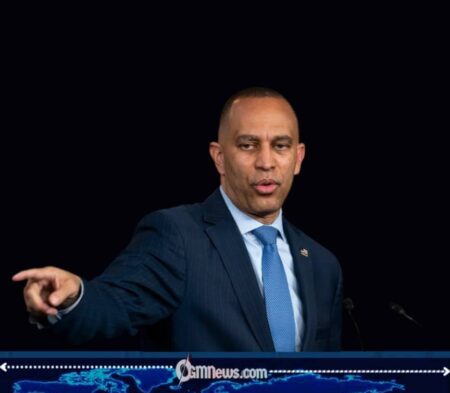
House Democratic Leader Hakeem Jeffries has publicly challenged President Donald Trump to a debate “anytime, anyplace,” intensifying an already bitter exchange between two of the most prominent figures in American politics. The challenge came after Jeffries accused the president of relying on repeated “low IQ” insults rather than responding to substantive criticism.
He said he would welcome a direct confrontation with the president, arguing that Americans deserve political leadership focused on ideas rather than personal attacks. His remarks reflected a sharper tone from Democratic leadership as tensions continue to rise in Washington.
The exchange has quickly become one of the most closely watched political clashes of the week, highlighting a growing willingness among Democratic leaders to answer the president’s rhetoric with equally direct language.
How the Dispute Began
The confrontation began after President Trump again used one of his familiar attacks against a political opponent, describing Jeffries in dismissive terms during a public appearance. The president has frequently used intelligence-based insults against critics throughout his political career, often turning policy disputes into personal exchanges.
Jeffries responded by rejecting the characterization and suggesting that such language reveals more about the White House than its critics. He argued that repeated personal insults have become a substitute for meaningful political engagement.
The Democratic leader then escalated the exchange further by saying he had no hesitation in debating the president publicly, insisting he was confident in how such an encounter would be received by the American public.
Jeffries Adopts a More Aggressive Tone
For much of his leadership, Jeffries has often projected a more measured style than some members of his party. However, recent months have shown a noticeable shift in his willingness to confront the administration directly.
Political analysts say Jeffries appears increasingly prepared to meet President Trump on rhetorical ground that many Democrats previously avoided. By challenging the president openly, he may be attempting to show voters that Democratic leadership can respond forcefully without abandoning discipline.
Supporters of Jeffries say the approach reflects a recognition that traditional political restraint may no longer be enough in an era dominated by rapid media cycles and personal political branding.
The Politics of Personal Insults
President Trump has long used personal labels to define opponents, and his repeated use of intelligence-related insults has become a familiar part of his political style. Supporters often see those attacks as signs of bluntness and confidence.
Critics argue that such rhetoric weakens public discourse by shifting national attention away from policy. Jeffries suggested that reducing serious political disagreements to personal attacks does little to address the issues facing voters.
The latest exchange has renewed debate over whether modern political communication is becoming more about spectacle than substance, especially as both parties prepare for future electoral battles.
Reactions Across the Political Spectrum
Democrats have largely rallied behind Jeffries, with some praising his willingness to confront the president directly. Several party members privately said the challenge demonstrated a stronger and more confident leadership style.
Republicans dismissed Jeffries’ remarks as political theater, arguing that the Democratic leader was attempting to generate headlines rather than advance policy. Some Trump allies suggested the president’s criticism had succeeded in drawing Jeffries into a public confrontation.
Independent observers note that such exchanges often resonate beyond Washington because they can shape how voters perceive leadership strength, confidence, and political authenticity.
What the Confrontation Could Mean Ahead
The public challenge may have implications beyond a single news cycle. Political strategists say the episode could signal a broader Democratic strategy of engaging President Trump more directly during his second term in office.
Rather than allowing the White House to dominate public messaging, Democrats may increasingly attempt to challenge the president in ways that attract equal media attention. Jeffries’ remarks could represent an early example of that approach.
Whether the president accepts the challenge or ignores it, the exchange underscores how political confrontation continues to define the national conversation as the country moves deeper into another high-stakes political period.
[…] […]