



























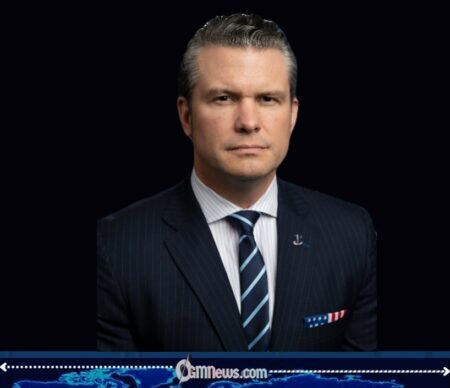
U.S. Defense Secretary Pete Hegseth has ignited a fresh wave of political and religious debate after likening sections of the American media to biblical adversaries of Jesus Christ. Speaking during a Pentagon briefing on the ongoing U.S.-Israeli conflict with Iran, Hegseth accused what he described as “Trump-hating” journalists of exhibiting hostility comparable to that of ancient Pharisees. His remarks come at a time of heightened tensions involving U.S. President Donald Trump, the media, and religious leaders, including Pope Leo.
Hegseth Remarks Trigger National Debate
Hegseth’s comments were delivered during an official Pentagon briefing, where he reflected on a recent church sermon. Drawing from Christian scripture, he described how Pharisees sought to undermine Jesus despite witnessing miracles, arguing that modern media outlets behave in a similar manner toward President Trump and his administration.
He clarified that his criticism was not directed at all journalists but specifically at what he termed the “legacy, Trump-hating press.” According to Hegseth, such media coverage focuses disproportionately on negative narratives, scrutinizing actions with the intent of discrediting rather than informing.
The remarks quickly circulated across major media platforms, prompting intense reactions from journalists, political analysts, and religious commentators. Critics argue that invoking religious analogies in this manner risks deepening divisions in an already polarized political environment.
Religious Language in War Messaging
The Defense Secretary’s comments are part of a broader pattern in which religious language has featured prominently in official discourse surrounding the Iran conflict. Both Hegseth and President Trump have referred to recent military developments in spiritual terms, including describing the Easter rescue of a downed U.S. airman as a “miracle.”
Hegseth’s increasing emphasis on his Christian faith has drawn attention throughout his tenure. Observers note that his rhetoric often blends policy messaging with religious framing, particularly when discussing military operations and national security.
While the use of faith-based language in wartime is not unprecedented in U.S. history, analysts suggest the current administration’s tone is more explicit and frequent. This approach has generated support among some religious groups while raising concerns among others about the boundaries between governance and personal belief.
Viral Prayer and Cultural References
Further controversy emerged following a Pentagon prayer service led by Hegseth, where he recited a prayer adapted from the film Pulp Fiction. The prayer echoed a stylized version of a biblical passage often associated with the character played by Samuel L. Jackson.
The clip quickly went viral online, drawing criticism and confusion over its origins. In response, Pentagon spokesperson Sean Parnell clarified that Hegseth was aware the version cited was not a direct biblical quotation but rather a cultural adaptation inspired by Ezekiel 25:17.
Despite the clarification, the incident fueled further debate about the appropriateness of blending pop culture references with religious expression in official government settings, particularly within the military establishment.
Escalating Tensions with Religious Leadership
The controversy has also intensified an ongoing rift between the Trump administration and Pope Leo. The pontiff, who has previously criticized the war effort, issued a strongly worded statement shortly after the Pentagon briefing.
In a post on social media platform X, Pope Leo warned against the manipulation of religion for political or military purposes, cautioning that such actions risk undermining the sanctity of faith. His remarks were widely interpreted as a direct response to Hegseth’s statements and the administration’s broader rhetoric.
The exchange highlights growing tensions between political leadership in Washington and segments of global religious authority, particularly on issues related to war, morality, and the role of faith in public life.
Media Relations and Legal Battles
Hegseth’s criticism of the press is not new but has intensified in recent weeks. He has repeatedly accused major media outlets of bias against President Trump, framing their coverage as politically motivated rather than objective journalism.
This conflict has extended into the legal arena, with the Pentagon currently appealing a federal court ruling that struck down its media credentialing policy as unconstitutional. The case has drawn significant attention as a test of press freedom and government authority.
Media organizations and advocacy groups have expressed concern that such measures could restrict access and undermine transparency, while administration officials argue they are necessary to ensure accountability and national security.
Historical Context and Expert Analysis
Historians note that American leaders have long invoked religious themes during times of war. However, experts such as John Fea of Messiah University argue that the current administration’s rhetoric stands out for its intensity and directness.
According to Fea, the explicit comparison of political critics to biblical adversaries marks a notable departure from more traditional, unifying uses of religious language. He suggests this approach may resonate strongly with certain constituencies while alienating others.
The ongoing debate underscores broader questions about the intersection of religion, politics, and media in contemporary America, particularly during periods of international conflict and domestic polarization.
A Deepening National Conversation
Hegseth’s remarks have added a new dimension to an already complex political landscape, intertwining issues of faith, media credibility, and wartime leadership. As reactions continue to unfold, the episode is likely to remain a focal point in discussions about the role of religious rhetoric in public office.
With tensions persisting between the administration, the press, and religious figures, the controversy reflects deeper divisions that extend beyond a single statement. Whether these divisions will widen or prompt renewed dialogue remains uncertain, but their impact on public discourse is unmistakable.


The weekly tournaments here keep me coming back because the prize pools are surprisingly generous....