

























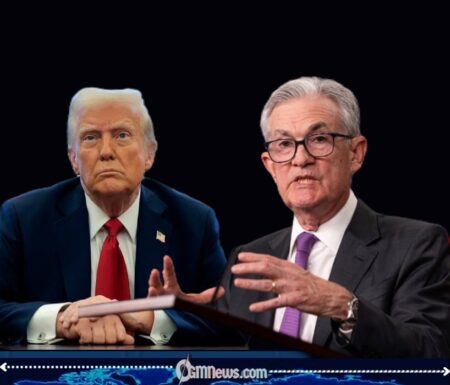
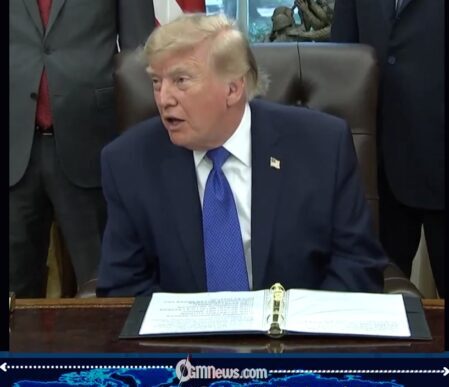
President Donald Trump, currently serving his second term in office, has intensified his pressure on the United States Federal Reserve, renewing threats to dismiss its chair, Jerome Powell, while advancing plans to install a preferred successor. The unfolding standoff highlights a deepening clash over monetary policy, institutional independence, and political influence at the highest levels of economic governance.
At the centre of the dispute is Trump’s insistence that the Federal Reserve should aggressively cut interest rates—an approach that sharply contrasts with Powell’s cautious stance. With Powell’s tenure nearing its official end in mid-May, the situation has triggered political manoeuvring in Washington, raising questions about the future leadership of the central bank and the limits of presidential authority.
Escalating Threats Ahead of Leadership Transition
Tensions escalated after President Trump publicly declared that he would consider removing Powell if he remained in office beyond the expiration of his term. In a televised interview, Trump stated he had previously “held back” from taking such action but would not hesitate if the transition did not proceed as expected.
The remarks underscore a prolonged friction between the White House and the Federal Reserve. Trump has repeatedly criticised Powell’s leadership, arguing that the central bank has failed to act decisively in lowering borrowing costs. His latest comments signal a willingness to escalate the confrontation at a critical juncture for U.S. economic policy.
Trump And Powell Clash Over Interest Rate Policy
The dispute between Trump and Powell is rooted in fundamentally different approaches to monetary policy. Trump has consistently advocated for lower interest rates, claiming such measures would stimulate economic growth and strengthen market performance.
In contrast, Powell and other officials at the Federal Reserve have maintained a more measured approach, emphasizing the need to balance inflation control with sustainable economic expansion. This divergence has placed the central bank on a collision course with the administration, raising concerns among economists about political interference in monetary decisions.
Warsh Nomination Faces Senate Scrutiny
Amid the uncertainty, the White House has put forward Kevin Warsh as its nominee to succeed Powell. Warsh, a former Federal Reserve governor, is widely viewed as more aligned with Trump’s economic outlook, particularly on interest rate reductions.
However, his confirmation faces hurdles in the Senate, where approval is required. Lawmakers have expressed reservations, not only about Warsh’s policy stance but also about the broader context surrounding his nomination. The upcoming confirmation hearing is expected to be a pivotal moment in determining the future direction of U.S. monetary policy.
Justice Department Investigation Complicates Process
Further complicating the situation is an ongoing investigation by the Department of Justice into renovations at the Federal Reserve’s headquarters in Washington, D.C. The probe has drawn political attention and added another layer of controversy to the leadership transition.
Reports indicate that investigators have taken an active interest in the construction project, examining its cost and management. President Trump has seized on the issue, alleging—without presenting evidence—that the project reflects incompetence or possible corruption. These claims have intensified scrutiny of Powell’s tenure.
Republican Divisions and Senate Resistance
The investigation has also exposed divisions within Trump’s own party. Thom Tillis, a Republican member of the Senate Banking Committee, has publicly stated that he may block Warsh’s nomination until the Justice Department concludes its inquiry.
While expressing support for Warsh in principle, Tillis described the investigation into Powell as approaching “the point of absurd,” signalling frustration with how the issue is being handled. His stance highlights the delicate political balancing act facing Senate Republicans as they navigate loyalty to the administration and institutional concerns.
Legal Uncertainty Over Presidential Authority
Even if Trump proceeds with efforts to remove Powell, legal experts note that the outcome is far from certain. The authority of a president to dismiss a Federal Reserve chair without clear cause remains a contested issue.
The Supreme Court of the United States is already considering related questions in a separate case involving the dismissal of a Federal Reserve governor. Early indications from oral arguments suggest skepticism among justices about expanding presidential powers over the central bank, potentially setting the stage for a landmark ruling.
Broader Implications for Central Bank Independence
The ongoing confrontation raises broader concerns about the independence of the Federal Reserve, a cornerstone of U.S. economic stability. Powell has previously warned that political pressure could undermine the institution’s ability to make evidence-based decisions.
As the May deadline approaches, the outcome of this dispute could have lasting implications not only for U.S. monetary policy but also for global financial markets. Observers are closely watching whether institutional norms will withstand the mounting political pressure.

[…] […]