













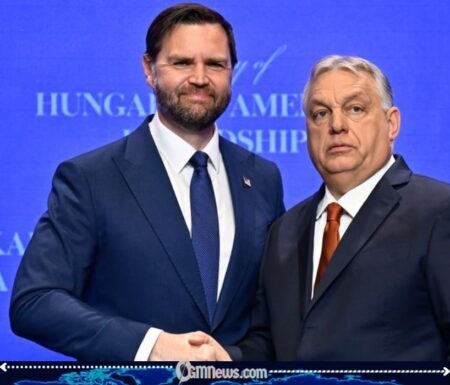
In a high-profile visit to Hungary, U.S. Vice President JD Vance publicly endorsed Prime Minister Viktor Orbán while accusing the European Union of attempting to influence the country’s upcoming national election. The remarks, delivered in Budapest days before the April 12 vote, have intensified international attention on a closely contested race that could reshape Hungary’s political trajectory.
Vance’s comments come amid mounting scrutiny of foreign involvement in domestic elections globally. While acknowledging accusations that his own presence could be viewed as interference, the U.S. vice president argued that financial and political pressure from Brussels constitutes a more serious form of external influence. The exchange has sparked a sharp response from EU officials and added a new dimension to Hungary’s already polarized electoral contest.
Vance Endorsement Signals Strategic Alignment
During public remarks in Budapest, Vance openly praised Orbán’s leadership, describing him as a defender of national sovereignty and traditional values. He framed Hungary as a critical partner aligned with the United States under President Donald Trump, emphasizing what he called a shared commitment to Western civilization.
Vance stated that his visit was intended “to help” Orbán secure re-election, marking an unusually direct endorsement by a sitting U.S. vice president in a foreign electoral process. Addressing a large crowd, he urged Hungarian voters to support Orbán, portraying the election as a defining moment for the country’s future direction.
The vice president also highlighted themes such as border security, cultural identity, and economic stability, presenting Hungary under Orbán as a model for resisting liberal political trends. His speech framed the election as part of a broader ideological struggle extending beyond national borders.
Accusations of EU Interference Stir Controversy
A central element of Vance’s address was his accusation that the European Union is exerting undue influence over Hungary’s democratic process. He criticized the bloc for withholding billions of euros in funding, linking the move to disagreements over Hungary’s domestic policies.
Vance argued that such financial pressure undermines national sovereignty, contrasting it with criticism directed at his own visit. He described the situation as “darkly ironic,” asserting that while his actions were labeled as interference, EU measures were not subjected to the same scrutiny.
The comments reflect ongoing tensions between Hungary and the EU, particularly over rule-of-law concerns and governance standards. Orbán’s administration has frequently clashed with Brussels on issues ranging from judicial independence to media freedom.
EU Officials Reject Claims, Defend Democratic Standards
Officials from the European Union swiftly responded to Vance’s remarks, rejecting allegations of interference. A spokesperson for the European Commission emphasized that elections within member states are determined solely by voters.
The EU also pointed to regulatory frameworks such as the Digital Services Act, which aims to safeguard democratic processes by addressing risks posed by online platforms. Officials stressed that these measures are designed to protect, rather than undermine, electoral integrity.
Diplomatic channels between the EU and the United States are expected to address the controversy. EU representatives indicated that concerns over Vance’s statements would be communicated directly to American counterparts, underscoring the sensitivity of the issue.
A Tight Race Shapes Hungary’s Political Future
Prime Minister Orbán is seeking a fifth consecutive term in office, but faces a significant challenge from opposition leader Péter Magyar. According to independent polling cited by international observers, Orbán’s party, Fidesz, trails its main rival among decided voters.
The election is widely viewed as one of the most competitive in Hungary’s recent history. Analysts suggest that voter turnout and undecided voters could play a decisive role in determining the outcome.
The campaign has been marked by sharp divisions over Hungary’s direction, with Orbán emphasizing national sovereignty and traditional values, while the opposition has called for closer alignment with European institutions and democratic reforms.
Concerns Over Democratic Standards Persist
International organizations, including Freedom House, have raised concerns about Hungary’s democratic environment. The country is currently classified as “partly free,” with criticisms focusing on electoral fairness and the independence of key institutions.
Observers have also pointed to restrictions on media and civil society as factors affecting the political landscape. These issues have contributed to ongoing disputes between Hungary and the European Union, particularly regarding funding and compliance with shared standards.
Despite these concerns, Orbán retains strong support among segments of the population, particularly for his stance on immigration and national identity. His campaign continues to emphasize stability and continuity.
Geopolitical Implications Extend Beyond Hungary
Hungary’s relationship with Russia and its position within the European Union have added a geopolitical dimension to the election. Under Orbán, the country has pursued closer ties with Moscow, a stance that has drawn criticism from Western allies.
Vance’s visit underscores the broader international stakes, reflecting alignment between Hungary’s leadership and elements within the U.S. administration. President Trump’s public praise for Orbán during the visit further highlights this connection.
As Hungary prepares to vote, the outcome is likely to influence not only domestic policy but also the country’s role within Europe and its relationships with global partners. The election has become a focal point for debates over sovereignty, democracy, and international influence.

The vibes here are amazing and the winning streaks are real. It feels just like...