














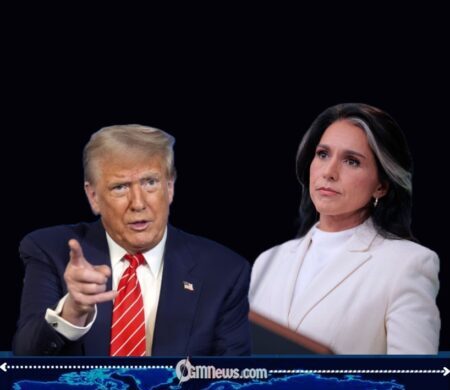
In a rapidly evolving national security debate in Washington, Tulsi Gabbard has publicly defended the authority of Donald Trump—currently serving a second term as President of the United States—to determine what constitutes an imminent threat, following his decision to authorize military action against Iran. Her remarks come amid heightened scrutiny over intelligence assessments, internal disagreements, and the resignation of a senior official within the intelligence community.
The controversy underscores longstanding tensions between political leadership and intelligence interpretation, particularly in matters of war powers. While Gabbard emphasized the president’s constitutional role as commander-in-chief, critics and observers have pointed to ambiguity in her position, especially given her past opposition to military escalation involving Iran.
Intelligence Leadership Responds to Internal Dispute
Gabbard’s statement followed the resignation of her deputy, Joe Kent, whose departure drew attention after he questioned the narrative surrounding Iran as an imminent threat. In his resignation communication, Kent suggested that certain international actors and media voices had influenced perceptions within the administration, raising concerns about the integrity of intelligence inputs.
Without naming Kent directly, Gabbard responded by reaffirming the institutional role of her office. She stated that the Office of the Director of National Intelligence is tasked with synthesizing and presenting the most accurate intelligence available to inform presidential decisions. However, she made clear that the ultimate judgment rests with the president.
Her remarks appeared to sidestep the core of Kent’s claims, instead focusing on procedural clarity. This approach has been interpreted by some analysts as an attempt to maintain institutional neutrality while reinforcing executive authority.
Presidential Authority and the Question of “Imminent Threat”
Central to the debate is the definition of what constitutes an “imminent threat.” Gabbard asserted that President Trump, having been elected by the American public, holds the responsibility to make that determination based on the intelligence presented to him.
President Trump has repeatedly argued that Iran posed an urgent danger, citing claims that the country was close to developing a nuclear weapon and could potentially deploy it. He justified prior military actions—including strategic strikes on Iranian nuclear-related facilities—on these grounds.
However, critics note that the administration has not publicly released verifiable evidence supporting these assertions. The lack of transparency has fueled skepticism among policymakers, intelligence experts, and segments of the public.
Scrutiny from Journalists and Policy Observers
Media figures, including Jonathan Karl, have highlighted what they describe as a notable omission in Gabbard’s statement. Karl pointed out that she did not explicitly affirm that Iran met the threshold of an imminent threat, nor did she confirm that intelligence findings supported such a conclusion.
This omission has become a focal point in the broader discourse, raising questions about whether intelligence officials are aligning with political decisions or maintaining independent analytical positions. Observers argue that such distinctions are critical in preserving public trust in national security institutions.
The debate also reflects a wider concern about how intelligence is communicated to both decision-makers and the public, particularly in situations that may lead to military engagement.
Gabbard’s Past Statements Resurface
Gabbard’s current stance contrasts sharply with her earlier positions during her 2020 presidential campaign. At the time, she warned that military conflict with Iran could surpass the scale and consequences of previous U.S. engagements in Iraq and Afghanistan.
She had also criticized unilateral military actions by the executive branch, introducing legislative proposals aimed at limiting presidential authority to initiate war without congressional approval. Her past remarks framed such actions as potentially unconstitutional and destabilizing.
Additionally, Gabbard was a vocal critic of the 2020 U.S. strike that killed Qassem Soleimani, describing it as an act that risked plunging the United States into a broader regional conflict.
Intelligence Community and Historical Context
The current debate has revived longstanding concerns about the role of intelligence in shaping foreign policy. References have been made to previous conflicts, particularly the Iraq War, where intelligence assessments were later found to be flawed or misrepresented.
In past interviews, Gabbard herself warned about the potential for intelligence manipulation, cautioning that internal and external pressures could influence how threats are portrayed. These earlier statements have added another layer of complexity to her current defense of executive decision-making.
The situation has prompted renewed calls for transparency and accountability within the intelligence community, especially when assessments are used to justify military action.
Ongoing Debate Over Evidence and Policy Direction
At the heart of the issue remains the question of evidence. While the Trump administration has asserted that Iran was nearing nuclear capability, publicly available intelligence assessments have not confirmed such claims. Earlier reports from U.S. intelligence agencies indicated that Iran halted its nuclear weapons program in 2003, with no conclusive evidence of its resumption.
The administration has also suggested that Iran harbored intentions to attack both Israel and the United States, though these claims have not been substantiated with publicly disclosed intelligence.
As the debate continues, policymakers face the challenge of balancing national security imperatives with the need for credible, transparent evidence. The outcome may have lasting implications for U.S. foreign policy and the role of intelligence in democratic governance.

[…] […]