



























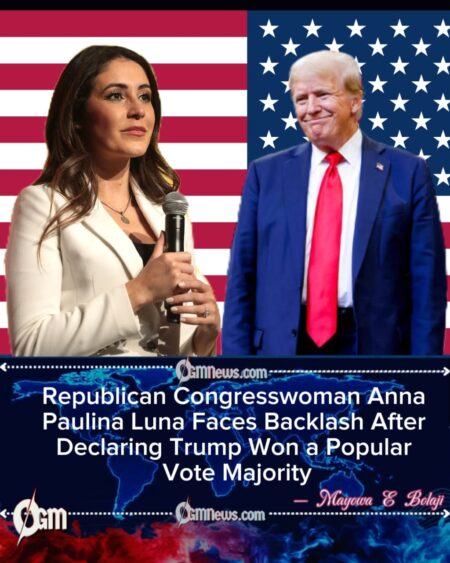
Republican congresswoman Anna Paulina Luna has come under scrutiny after claiming that U.S. President Donald Trump won an “overwhelming majority” of the national popular vote. The statement quickly attracted attention from political analysts, journalists, and fact-checking organizations, many of whom pointed out inconsistencies between the claim and official election records.
Trump, who is currently serving a second term as president of the United States, has never secured more than half of the national popular vote in the presidential elections he contested. While he achieved victories through the Electoral College system, his nationwide vote share did not exceed the 50 percent threshold typically required to claim a majority.
The comment by Luna has sparked renewed public discussion about political messaging, election data, and the importance of accurately describing electoral outcomes.
Anna Paulina Luna’s Statement and Political Context
The controversy began when Anna Paulina stated that Trump had won an “overwhelming majority” of the popular vote. Her remarks circulated widely online, prompting debate among commentators who questioned the accuracy of the claim.
Political observers noted that describing an election result as a “majority” suggests that a candidate received more than half of all votes cast nationwide. Election statistics from recent presidential contests show that Trump’s vote share remained below that threshold.
Critics argue that Luna’s description exaggerates the scale of Trump’s popular vote support, while some supporters interpret her remark as political rhetoric meant to emphasize the strength of his electoral victories.
Anna Paulina Luna at the Center of Fact-Checking Efforts
Following Anna Paulina’s statement, fact-checking groups and election analysts quickly reviewed the data from recent presidential elections. Their findings reiterated that Trump’s Electoral College victories did not coincide with winning a majority of the national popular vote.
Election experts explained that political language sometimes blurs the distinction between a candidate’s Electoral College success and their share of the nationwide vote. In this case, analysts said the wording used by Luna could lead to confusion about the actual numbers.
As a result, Luna’s comment became the focal point of wider discussions about how political figures frame election outcomes and the importance of precise language when referencing electoral statistics.
Understanding the Difference Between Popular Vote and Electoral College
The debate surrounding Luna’s claim has once again highlighted the structural differences in the U.S. electoral system. The popular vote counts the total number of ballots cast for each candidate across the entire country.
However, the presidency is decided through the Electoral College, where each state assigns electors based on the outcome of its state-level vote. Most states award all their electors to the candidate who wins the state’s popular vote.
Because of this system, it is possible for a candidate to win the presidency without winning the national popular vote — a scenario that has occurred several times in American history and continues to generate political debate.
Election Data and Trump’s Vote Share
In the 2016 election, Trump defeated Hillary Clinton in the Electoral College, despite Clinton receiving a larger share of the national popular vote. Clinton secured about 48 percent of the vote, while Trump received roughly 46 percent.
During the 2020 election, Trump ran against Joe Biden, who won both the popular vote and the Electoral College. Biden obtained slightly more than 51 percent of the vote nationwide, while Trump received approximately 47 percent.
These figures confirm that Trump has not won more than half of the national popular vote in presidential elections, contradicting Luna’s description of an “overwhelming majority.”
Broader Implications of Anna Paulina Luna’s Claim
The attention surrounding Luna’s statement reflects a broader concern about the accuracy of political messaging. Experts note that public officials’ comments often shape how voters understand complex electoral systems.
Scholars of American politics argue that precise language is essential when discussing election outcomes. Misstatements, even when unintentional, can contribute to misunderstandings about how the democratic process functions.
As political debates intensify in the United States, the scrutiny of statements like Luna’s illustrates the ongoing role of journalists, analysts, and researchers in verifying claims made by elected officials.
Continuing Debate Over Political Narratives
The episode has also reignited discussion about how election results are interpreted and communicated to the public. Supporters of Trump often emphasize his Electoral College victories, while critics point to the national popular vote totals as a measure of broader voter support.
For observers of American politics, the controversy surrounding Anna Paulina Luna’s claim demonstrates how a single statement can trigger widespread debate about electoral facts, political rhetoric, and the responsibility of leaders to present accurate information.
As the conversation continues, analysts say that transparent access to election data remains crucial for maintaining public trust and informed democratic discourse.


https://shorturl.fm/vJtLQ