



























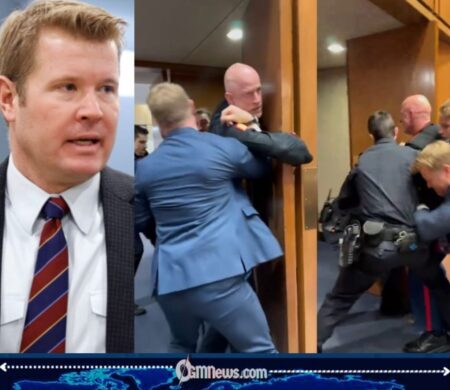
Senator Tim Sheehy and security personnel sought to remove Brian McGinnis, a veteran and political candidate affiliated with the Green Party, after he interrupted proceedings with a political statement. Sheehy maintains that the removal was conducted in accordance with established security protocols intended to preserve order within the chamber.
Sheehy states that the injury sustained by McGinnis occurred accidentally when the protester’s hand became trapped in the door frame during the escort. Supporters of Sheehy argue that maintaining decorum in congressional hearings is essential for effective governance and legislative deliberation. Witnesses reported immediate expressions of alarm from observers who believed the Marine’s hand had been injured, raising questions about whether the procedure used to remove the protester was proportionate.
The incident has drawn widespread attention across political and media circles, with commentators debating the balance between free expression and institutional order. Critics contend that the handling of the protest may have been excessive, while defenders insist that disruptions in formal proceedings cannot be permitted to derail the legislative process. The controversy underscores broader tensions in American politics regarding dissent and security within governmental spaces.
Details of the Encounter and Allegations
The details of the encounter reveal a tense exchange that preceded the removal of McGinnis from the hearing room. Reports indicate that McGinnis voiced strong objections to U.S. foreign policy, particularly military engagement in the Middle East and decisions linked to the administration of President Donald Trump. Supporters of Sheehy contend that such protests, while permissible in public discourse, must be conducted in ways that do not disrupt official proceedings.
Sheehy later described the situation as an attempt to de-escalate a confrontation that had grown disruptive. He denied any intent to cause harm, emphasizing that security personnel acted to restore order and protect the integrity of the hearing.
Critics of Sheehy argue that greater care should have been taken to ensure the safety of the protester during the removal process.
The incident has raised broader questions about the treatment of political dissent in governmental spaces. Advocates for McGinnis maintain that nonviolent protest is a fundamental democratic right and that excessive force undermines public confidence in institutions. Supporters of Sheehy counter that congressional hearings are not venues for sustained demonstrations and must remain focused on legislative business.
Reactions and Political Implications
Reactions to the incident have been sharply divided along political lines. Some lawmakers and advocacy groups describe the event as emblematic of growing polarization and intolerance in American politics, while others emphasize the necessity of enforcing rules within formal settings.
Defenders of Sheehy argue that the senator acted responsibly under challenging circumstances.
Critics of Sheehy, conversely, view the episode as evidence of a broader pattern in which dissenting voices are met with disproportionate responses. They contend that political institutions must accommodate protest and dialogue to preserve democratic legitimacy. Supporters respond that such accommodation must not compromise the functionality of governmental processes.
The incident has also become a subject of media scrutiny and public debate, with social media platforms amplifying diverse perspectives. Observers note that modern political controversies often unfold rapidly in digital spaces, shaping public opinion before official investigations are completed. The case illustrates the challenges of navigating information and perception in the contemporary media environment.
Background of the Protest and Policy Criticism
The background of the protest centers on McGinnis’s objections to U.S. military and foreign policy decisions. He referenced concerns about the human and financial costs of prolonged engagement in conflict zones and criticized what he described as unnecessary intervention. Critics of such policies argue that they often fail to achieve lasting stability and may exacerbate regional tensions.
Supporters of intervention, by contrast, maintain that strategic action is sometimes required to protect national security and international alliances. The debate reflects longstanding divisions in American political discourse regarding the appropriate role of the United States on the global stage. The incident underscores how these disagreements can manifest in emotionally charged settings.
The case also highlights the role of veterans in political advocacy. McGinnis, who previously served in the military, has positioned himself as a voice for those opposed to further conflict. Observers note that veterans often bring unique perspectives to policy debates, informed by firsthand experience.
Political Fallout and Public Discourse
Political fallout from the incident continues to evolve as lawmakers and commentators assess its implications. Calls for greater civility in political discourse have accompanied discussions about security protocols in congressional spaces. Proponents of reform argue that clearer guidelines could help prevent similar incidents in the future.
The debate also reflects broader concerns about the tone of contemporary politics. Polarization and rhetorical hostility, some analysts contend, hinder constructive dialogue and compromise. Supporters of robust debate counter that strong disagreement is a natural feature of democratic governance.
Public discourse surrounding the event demonstrates the complexities of balancing free expression with institutional order. While opinions vary widely, many observers agree on the importance of addressing underlying tensions through dialogue and transparency. The incident serves as a reminder of the challenges inherent in modern political life.
Calls for Investigation and Accountability
Calls for investigation into the incident have been made by advocacy groups and some members of Congress. They argue that a thorough review is necessary to determine whether procedures were followed appropriately and to ensure accountability. Sheehy has expressed support for any inquiry that seeks to clarify the facts.
A potential investigation would likely examine security protocols, witness testimony, and available video evidence. Such processes are standard in cases involving disputes over conduct within governmental settings. Legal and ethical experts note that the findings of an investigation could influence public perceptions of institutional transparency.
Sheehy remains committed to cooperation and de-escalation as the situation unfolds. He has reiterated that his actions were motivated by a desire to maintain order and uphold the integrity of the hearing. The case highlights the importance of balancing security with respect for individual rights.
[…] […]