




























A newly surfaced photograph from Department of Justice files has intensified scrutiny on Commerce Secretary Howard Lutnick, prompting bipartisan calls for testimony before Congress. Lawmakers from both parties are seeking clarification regarding Lutnick’s past association with the late financier Jeffrey Epstein, following reports that an image allegedly depicting the two on a tropical island was removed from a Justice Department website.
The development has placed Lutnick — a key economic adviser to President Donald Trump, who is currently serving his second term as U.S. president — under mounting political pressure. While Lutnick has not been accused of wrongdoing, inconsistencies between his prior public statements and newly released records have drawn heightened attention from congressional investigators.
The Photo and the Department of Justice Response
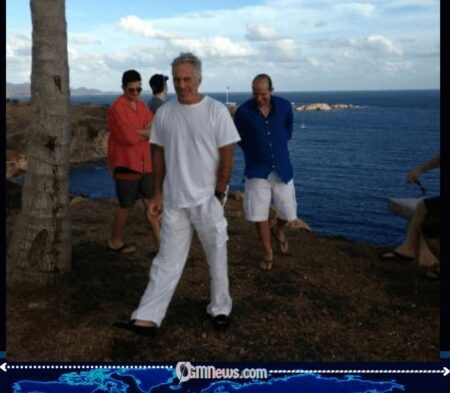
The image in question reportedly shows Lutnick alongside Epstein and three unidentified individuals on what appears to be Little St. James, Epstein’s private island in the U.S. Virgin Islands. The photograph resurfaced as part of newly released Justice Department materials connected to the broader review of Epstein-related documents.
Representative Thomas Massie, who has advocated for broader transparency in the Epstein files, publicly questioned why the image was reportedly deleted from the DOJ website. Writing on X, Massie urged the department to explain who removed the file and under what authority, emphasizing the need for accountability in the handling of sensitive records.
The Department of Justice has not publicly addressed the removal of the image. The White House did not immediately respond to requests for comment, and Lutnick’s office has not issued a formal statement regarding the photograph.
Contradictions Between Public Statements and Released Records of Lutnick
The renewed scrutiny stems in part from Lutnick’s earlier assertions about his limited contact with Epstein. In an October interview with the New York Post, Lutnick stated that he had interacted with Epstein only once and described the financier in strongly negative terms, insisting he had no social, business, or philanthropic relationship with him.
However, documents released in January appear to contradict aspects of that account. Emails suggest that Lutnick visited Epstein’s Little St. James island in 2012 for lunch — years after Epstein’s 2008 conviction for sexual offenses. Correspondence indicates that Lutnick’s wife contacted Epstein’s office regarding travel arrangements to the island, and follow-up messages referenced a meeting between the two men.
Earlier this month, Lutnick acknowledged in congressional testimony that he visited the island with his family. Speaking before a Senate Appropriations subcommittee on February 10, he maintained that he did not have a substantive relationship with Epstein, stating that he “barely had anything to do with that person.”
Oversight Committee Considers Further Action
The House Oversight Committee has emerged as a focal point of the growing investigation. Oversight Chair James Comer indicated that the panel is considering additional questioning of Lutnick and has not ruled out issuing a subpoena for a deposition.
Comer described the inquiry as bipartisan and emphasized that the committee intends to examine associations across party lines. His comments came shortly after former Secretary of State Hillary Clinton testified before the committee in a separate matter, an appearance that has intensified calls from some lawmakers for Lutnick to undergo similar scrutiny.
Representative Nancy Mace, a vocal ally of President Trump, also signaled her intention to raise questions related to Lutnick’s past connections during committee proceedings.
Political and Financial Ties Under Review
Additional context surrounding Lutnick’s relationship with Epstein has drawn attention to political and financial interactions dating back more than a decade. Records indicate that Epstein and Lutnick exchanged messages in 2012 arranging a lunch meeting on Little St. James. A subsequent note from Epstein’s assistant reportedly read, “Nice seeing you.”
In 2015, Epstein’s assistant forwarded an invitation from Howard to a fundraising event at his financial firm for Hillary Clinton’s 2016 presidential campaign. Campaign finance records show that Lutnick donated $2,700 — the legal maximum individual contribution at the time — to Clinton’s campaign.
Lutnick has long been considered an influential figure within President Trump’s inner circle and a central architect of the administration’s economic strategy. His prominence has amplified the political ramifications of the unfolding controversy.
Resignation Calls and Broader Implications
The inconsistencies between Howard’s previous statements and the released documentation have prompted some lawmakers from both parties to call for his resignation. Others have stressed the importance of due process, noting that Howard has not been accused of criminal conduct.
The broader investigation into Epstein’s network continues to generate political fallout years after the financier’s death. As Congress weighs whether to compel further testimony, the focus remains on transparency, record accuracy, and the integrity of public officials.
For the Trump administration, the episode represents another test of its commitment to accountability as it navigates ongoing oversight inquiries during the president’s second term in office.
Casinoabc999? Good Site. The interface is sleek, and there is a lot of stuff to...