

























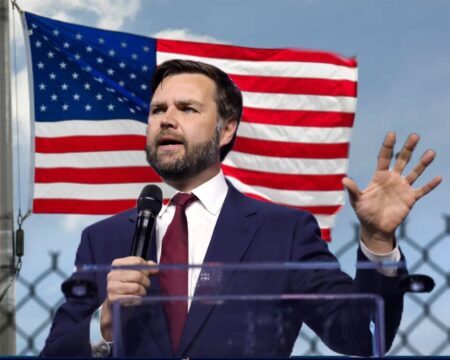
Vice President JD Vance has placed American workers at the center of the administration’s economic message, arguing that national prosperity should be built on the productivity and advancement of U.S. citizens. Speaking during a recent policy address, Vice President Vance stated that political leaders must be accountable to communities affected by wage stagnation and industrial shifts.
Vice President JD Vance said the administration’s goal is to ensure that businesses succeed by investing in American talent rather than relying on unauthorized labor. His remarks reflect a broader emphasis on reshaping incentives in the labor market and reinforcing domestic workforce participation.
Vice President JD Vance Criticizes Reliance on Unauthorized Labor
Vice President JD Vance asserted that some economic interests have benefited disproportionately from the use of undocumented immigrant labor. “They answer to people who got rich off of illegal immigrant labor,” he said, adding, “We want you guys to get rich off of the labor of American citizens.”
Vice President Vance framed the issue as one of fairness and accountability, maintaining that economic growth should directly improve wages and employment prospects for American workers.
According to the vice president, restoring balance in the labor market requires consistent enforcement of immigration laws and policies that reward lawful hiring practices.
Vice President JD Vance Links Immigration Policy to Wage Growth
Vice President Vance emphasized that immigration enforcement is closely connected to wage stability and job availability. Administration officials have pointed to increased workplace audits and border enforcement measures as part of a broader effort to protect domestic employment opportunities.
Under President Donald Trump, who is currently serving a second term, the White House has advanced what it describes as a labor-first economic strategy. Vice President JD Vance has been a leading voice in articulating how these policies aim to align business incentives with national workforce priorities.
Vice President JD Vance Addresses Business Community Concerns
Vice President Vance acknowledged that certain sectors, including agriculture and hospitality, have expressed concern about potential labor shortages. However, he argued that long-term economic resilience depends on cultivating a strong domestic workforce.
Vice President Vance highlighted vocational training initiatives and workforce development programs designed to prepare American citizens for high-demand roles. He suggested that investing in skills development could offset transitional challenges in industries adjusting to stricter compliance standards.
Vice President JD Vance at the Center of a Broader Policy Debate
Vice President Vance’s remarks have sparked debate across political and economic circles. Supporters contend that his focus on American workers reflects longstanding concerns about globalization and wage competition.
Critics, meanwhile, argue that immigration plays a significant role in supporting economic growth and innovation.
Despite differing perspectives, Vice President Vance has maintained that the administration’s objective is to strengthen domestic employment pathways while ensuring legal compliance across industries. As legislative discussions continue, his statements signal that labor policy will remain a defining feature of the administration’s second-term agenda.
Vice President JD Vance Signals Continued Focus on Workforce Reform
Vice President Vance indicated that additional measures may be introduced to reinforce the administration’s labor priorities. These could include expanded training programs, employer compliance initiatives, and legislative proposals aimed at reshaping hiring incentives.
Vice President Vance concluded by reiterating that economic success, in the administration’s view, should be measured by the prosperity of American workers. His remarks underscore a policy direction that seeks to place citizens’ employment opportunities at the forefront of national economic planning.

[…] […]