
























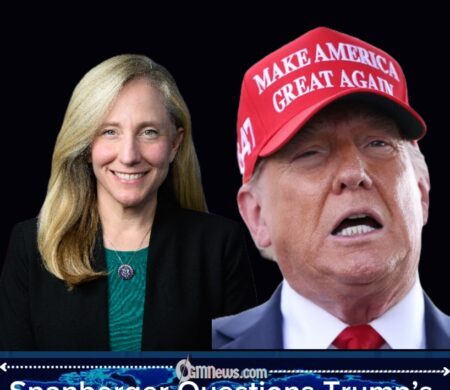
In a pointed and carefully structured rebuttal to President Donald Trump’s State of the Union address, Virginia Governor Abigail Spanberger declared that Americans “did not hear the truth” from the nation’s leader, focusing sharply on the rising cost of living, public safety concerns and constitutional rights.
Speaking shortly after President Trump—currently serving his second term—delivered his nearly two-hour address to Congress, Spanberger challenged the administration’s economic narrative. Her remarks, alongside a Spanish-language response from Senator Alex Padilla of California, underscored the Democratic Party’s renewed emphasis on affordability and civil liberties as central themes in opposition to the president’s agenda.
Spanberger Outburst Direct Challenge to the President’s Economic Record
Abigail Spanberger opened her 12-minute address with a direct appeal to voters, questioning whether President Trump’s policies have improved their daily lives. “We did not hear the truth from our president,” she said, urging Americans to reflect on whether the administration is “working for you.”
Throughout her rebuttal, Spanberger emphasized what Democrats describe as mounting financial pressures on households. Citing small businesses, farmers and working families, she argued that the administration’s now-invalidated tariff regime—recently struck down by the Supreme Court—had inflicted economic hardship rather than relief.
Polling data released ahead of the address showed that more than half of Americans wanted the president to prioritize economic issues. Spanberger’s remarks mirrored that concern, placing affordability at the center of her critique and reinforcing her party’s strategy of returning to what she described as “kitchen-table issues.”
Virginia’s Political Shift and a Message of Broad Appeal
Spanberger’s own electoral victory in November has been widely interpreted as a reflection of this economic focus. After eight years under former Republican Governor Glenn Youngkin, she secured a decisive win by approximately 527,000 votes—the largest raw-vote margin in Virginia’s history.
In her speech, Spanberger emphasized that her campaign drew support from Democrats, Republicans and independents alike. “They could demand more,” she said, arguing that voters were not constrained by party affiliation but instead motivated by practical concerns affecting their lives.
She also highlighted the Democratic majority in Virginia’s legislature and outlined early policy proposals aimed at subsidizing energy-efficiency upgrades, expanding affordable housing, reducing evictions and assisting residents with healthcare insurance premiums after Congress declined to restore certain federal subsidies.
Colonial Williamsburg as Symbolic Backdrop
Spanberger delivered her remarks from Colonial Williamsburg, a setting rich with historical symbolism. The site commemorates 18th-century Virginia life and was a focal point of early American independence movements.
It was in Williamsburg that colonists first declared their desire for independence from Britain. The city also hosted the introduction of the Virginia Declaration of Rights by George Mason, a foundational document that influenced the U.S. Bill of Rights.
By choosing this backdrop, Spanberger appeared to frame her criticism within a broader constitutional narrative, emphasizing limits on executive power and the preservation of civil liberties.
Immigration Enforcement and Civil Liberties Concerns
A substantial portion of Spanberger’s address focused on immigration enforcement and what she described as constitutional violations. She alleged that federal agents had detained individuals without warrants and had acted without adequate accountability.
The governor cited incidents involving families and immigrant communities, arguing that fear-based enforcement undermines both public trust and public safety. “Every minute spent sowing fear is a minute not spent investigating murders, crimes against children or the criminals defrauding seniors,” she said.
Meanwhile, Alex Padilla delivered a Spanish-language response echoing similar themes. He contended that the state of the union “does not feel strong for everyone,” particularly for families facing rising costs of rent, food and electricity. Padilla also referenced his own confrontation with federal agents during a 2025 press event led by Kristi Noem, describing it as emblematic of what he views as increasingly aggressive federal tactics.
Foreign Policy and National Security Critique
Spanberger broadened her critique beyond domestic concerns, challenging President Trump’s approach to foreign policy. She accused the administration of weakening alliances and ceding influence to geopolitical rivals, including Russia and China.
The governor expressed concern over what she characterized as instability in national security leadership, referencing mass firings under the Department of Government Efficiency (Doge) and appointments she described as lacking seriousness.
Her remarks reflected a wider Democratic argument that the administration’s actions risk undermining the United States’ long-standing global role. While President Trump emphasized perceived economic and diplomatic successes in his address, Spanberger framed the same developments as signs of retreat and diminished leadership.
A Divided Chamber and Visible Protest
The evening was also marked by visible dissent in the House chamber. Several Democratic lawmakers declined to stand during portions of President Trump’s address, and Representative Al Green was removed after displaying a protest sign during the speech.
Such moments underscored the heightened partisan atmosphere surrounding the State of the Union. Historically, rebuttals to presidential addresses have carried political risks, with past responses drawing mixed reviews. Spanberger’s measured tone and disciplined focus on economic concerns appeared designed to avoid those pitfalls while presenting a unified message.
[…] […]