




























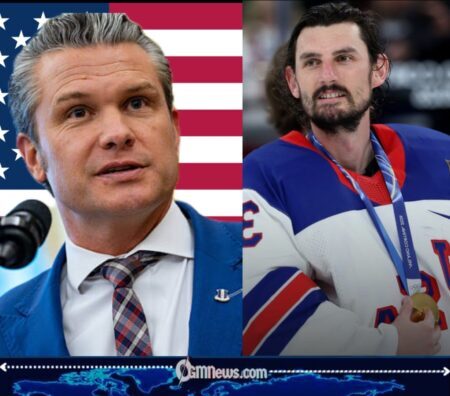
Pete Hegseth, United States Secretary of Defense became the center of public discussion after a social media post praising the defensive performance in the gold medal hockey game. Following the victory of the United States Olympic men’s ice hockey team in the Olympic men’s ice hockey gold medal game, Hegseth described goaltender Connor Hellebuyck as embodying exceptional defensive excellence. His statement—“Now we have a Secretary of War…and a Secretary of Defense!”—quickly circulated online, drawing both praise and criticism.
Observers noted that the comment appeared to be metaphorical, highlighting Hellebuyck’s pivotal role in securing the win. Supporters argued that the comparison celebrated athletic achievement and the importance of defense in both sports and national security. Critics, however, questioned the use of historical terminology, suggesting that such references might generate unnecessary controversy. The incident underscored how political figures’ remarks can rapidly become topics of broader public discourse.
Gold Medal Victory and National Pride
The gold medal triumph by the American hockey team added another milestone to the nation’s storied history in international competition. The game against Canada showcased high-level athleticism and strategic execution from both sides, but the United States ultimately prevailed.
Analysts emphasized that the victory reflected years of investment in player development and coaching.
Fans celebrated the achievement as a demonstration of teamwork and resilience. International hockey competitions often serve as platforms for friendly rivalry and national pride, and this match was no exception. The success of the American squad highlighted the continuing evolution of the sport and the increasing competitiveness of global tournaments.
Hegseth’s Role as Defense Chief
As Secretary of Defense, Pete Hegseth oversees critical aspects of national security and military policy. His tenure has included discussions about defense modernization and strategic readiness. Public comments by high-profile officials often attract significant attention, particularly when they intersect with cultural events such as major sporting competitions.
In this instance, Hegseth’s remark was interpreted by some as an expression of admiration for the goaltender’s defensive skills. Others viewed it through a political lens, debating the appropriateness of historical references in contemporary contexts. Regardless of perspective, the episode demonstrated how statements by government leaders can resonate beyond their immediate intent.
Hellebuyck’s Defensive Mastery
The performance of Connor Hellebuyck in the gold medal game was widely praised by commentators and teammates. Facing relentless offensive pressure, the goaltender delivered critical saves that kept the United States competitive throughout the match. His composure and technical ability were cited as defining factors in the team’s success.
Sports analysts noted that goaltending often plays a decisive role in tightly contested games. Hellebuyck’s contributions exemplified the importance of individual excellence within a team framework. His efforts not only secured the gold medal but also reinforced his reputation as one of the sport’s elite players.
Social Media Reaction and Public Dialogue
Hegseth’s post generated widespread discussion on social media platforms, where users expressed a range of opinions. Some praised the comment as a lighthearted tribute to defensive prowess, while others debated its historical connotations. The rapid dissemination of the statement illustrated the influence of digital communication in shaping public narratives.
Public figures and commentators emphasized the need for thoughtful discourse when addressing sensitive topics. While opinions differed, many participants in the conversation acknowledged the significance of celebrating athletic achievements. The episode highlighted the complex relationship between sports, politics, and modern media.
Historical Perspective on Terminology
The reference to the “Secretary of War” evokes historical terminology once used to describe the official responsible for military affairs in the United States. Over time, the title was replaced by Secretary of Defense to reflect changes in organizational structure and language. Contemporary references to the older term often carry symbolic or rhetorical meaning rather than official significance.
Debates about language and historical context are common in public discourse. In this case, the discussion centered on whether the metaphor appropriately honored defensive excellence or risked misunderstanding. Such conversations reflect the evolving nature of communication and the importance of contextual awareness.
Outlook for Team USA
With the gold medal secured, attention now turns to the future of the United States Olympic men’s ice hockey team and its prospects in upcoming international competitions. The team’s success in the Olympic men’s ice hockey gold medal game demonstrated its ability to perform at the highest level, setting expectations for continued achievement.
Coaches and players have emphasized the importance of maintaining momentum and building on recent accomplishments. International hockey remains highly competitive, with nations investing in talent development and strategic innovation. For the United States, the victory represents both a celebration of present success and a foundation for future aspirations.
The episode surrounding Pete Hegseth and the gold medal hockey victory illustrates the interconnected nature of sports, public life, and media discourse. While interpretations of his remark vary, the underlying achievement of the athletes remains undisputed. As international competition continues, such moments will likely continue to inspire conversation and reflection.



[…] […]