



























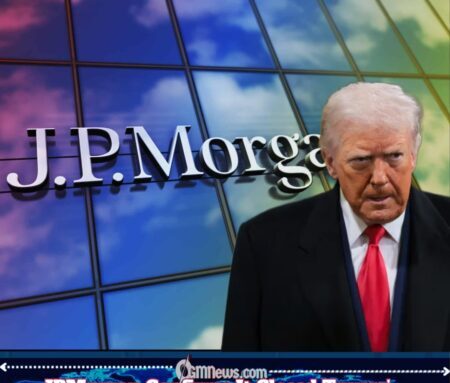
A political and financial storm has intensified after JPMorgan Chase, the largest bank in the United States by assets, acknowledged that it closed the personal and business accounts of President Donald Trump following the January 6, 2021 attack on the U.S. Capitol. The disclosure emerged as part of a $5 billion lawsuit filed by the president against the bank and its chief executive, Jamie Dimon.
The development has drawn strong reactions from conservative allies of the president, who argue that the decision reflects political bias within major financial institutions. The bank, however, has maintained that the lawsuit lacks merit, setting the stage for a legal and political battle with significant implications for corporate governance and executive accountability.
Account Closures Confirmed in Court Filings
Documents released during the discovery process show that JPMorgan sent two letters to President Trump on February 19, 2021, notifying him that dozens of his accounts would be closed. The correspondence did not cite a specific reason, stating only that the bank may determine that “a client’s interests are no longer served by maintaining a relationship with J.P. Morgan Private Bank.”
The letters provided a two-month window for the president to designate another financial institution to which his assets could be transferred. The timing of the closures—just weeks after the January 6 Capitol attack—has fueled claims from Trump’s supporters that the move was politically motivated.
JPMorgan did not immediately comment publicly on the newly disclosed documents. Legal representatives for the bank have previously stated that the claims against it are unfounded.
Legal Battle Intensifies
President Trump’s legal team filed the lawsuit in Florida state court on January 22, alleging that the bank’s actions were driven by “political and social motivations.” The complaint asserts that the closures caused substantial financial and reputational harm.
Central to the case is the invocation of the Florida Deceptive and Unfair Trade Practices Act (FDUTPA), which Trump’s attorneys argue allows for claims against Dimon personally. The bank’s lawyers have countered that FDUTPA exempts federally regulated bank officers from such suits and that Dimon was “fraudulently joined” to the case.
In February, JPMorgan sought to move the proceedings to federal court in Miami and ultimately to New York, arguing that most of the relevant accounts and business activities were based there. The jurisdictional dispute adds another layer of complexity to an already high-profile case.
Conservative Reaction and Political Fallout
The disclosure triggered swift responses from conservative figures. Former communications aide Steve Guest said the bank’s leadership had “serious explaining to do,” while longtime Trump strategist Jason Miller publicly criticized the decision in blunt terms.
Supporters argue that if a major financial institution can sever ties with a sitting president, ordinary Americans could face similar treatment based on political affiliation. Critics of that view, however, note that banks routinely reassess client relationships for a range of risk and reputational considerations.
The controversy has amplified broader debates about so-called “de-banking,” a term increasingly used in political discourse to describe the termination of financial services due to perceived ideological differences.
A Fraught Relationship Between Trump and Dimon
The relationship between President Trump and Jamie Dimon has long been marked by tension. Dimon has previously criticized the president’s understanding of economic policy, including remarks in 2023 regarding the U.S. debt ceiling debate.
At the time, President Trump suggested during a televised town hall that a temporary default might be preferable to unchecked government spending—a position most economists warned would have catastrophic consequences for domestic and global markets.
Dimon later backed former South Carolina governor Nikki Haley during the 2024 Republican primary, prompting President Trump to refer to him as a “highly overrated globalist.” Despite these tensions, JPMorgan contributed $1 million to the president’s second inauguration, joining other major corporate donors.
Broader Implications for Banking and Governance
The case raises broader questions about the responsibilities of financial institutions in politically sensitive contexts. Banks operate under strict regulatory frameworks and must balance reputational risk, compliance obligations, and shareholder interests.
Legal experts note that while banks generally retain the right to terminate client relationships, disputes may arise when high-profile political figures are involved. The outcome of this case could clarify the limits of corporate discretion in such circumstances.
As proceedings continue, the dispute between the nation’s largest bank and the current U.S. president serving a second term is likely to remain a focal point in debates about corporate power, political neutrality, and the intersection of finance and governance.

[…] […]