




























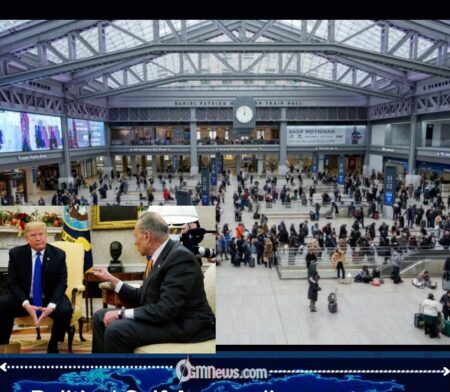
President Donald Trump, now serving his second term in the White House, is facing renewed scrutiny over reports that he sought to have New York’s Penn Station and Washington’s Dulles International Airport renamed in his honor. The proposal, tied to ongoing negotiations over federal infrastructure funding, has ignited debate in Congress and beyond about the proper limits of presidential influence and personal branding.
According to multiple accounts, Trump raised the possibility of renaming the two major transportation hubs during discussions with Senate Minority Leader Chuck Schumer. The controversy centers on whether the president linked support for a $16 billion infrastructure initiative in the Northeast to the renaming effort—an allegation that has been denied by the White House but continues to draw criticism.
The Gateway Project and the Funding Dispute
At the heart of the dispute lies the Gateway Program, a long-planned rail tunnel project beneath the Hudson River intended to connect New York and New Jersey. The multibillion-dollar initiative is widely viewed as critical to modernizing aging rail infrastructure and preventing major transportation disruptions along the Northeast Corridor.
In October, during a 43-day federal government shutdown, the administration announced it would withhold funds for the project pending a review of contracting practices. The stated justification at the time centered on concerns about diversity criteria in contractor selection. However, in subsequent statements, administration officials shifted their reasoning, arguing that Democratic lawmakers had been unwilling to negotiate on broader policy priorities, including immigration.
A federal judge later ordered the administration to release overdue payments, and more than $200 million has since been disbursed. Nonetheless, legal challenges remain ongoing, leaving the project’s long-term funding stability uncertain.
Conflicting Accounts and Political Fallout
President Trump has publicly denied that he demanded naming rights in exchange for releasing funds. He stated that Senator Schumer himself suggested renaming Penn Station after the president, a claim the New York Democrat swiftly rejected as false. White House press secretary Karoline Leavitt acknowledged that the president “floated” the idea during their conversation, adding further complexity to the timeline of events.
Critics argue that even raising such a proposal risks blurring the line between public governance and personal promotion. Supporters counter that discussions over naming federal facilities are ultimately a matter for Congress and reflect routine political negotiation.
The episode has intensified partisan tensions, with Democrats accusing the Trump administration of leveraging federal resources for symbolic gain, while Republicans have largely defended the president Trump’s actions as within his authority.
Expanding the President Trump
The reported push to rename Penn Station and Dulles International Airport is not an isolated case. During his second term, Trump has pursued a visible effort to attach his name to prominent national institutions. The board of trustees of the John F. Kennedy Center for the Performing Arts voted to add his name to the center after he restructured its leadership and appointed new members.
Additionally, Republican lawmakers have introduced proposals to rename Dulles Airport as “Donald J. Trump International Airport” and, in a separate initiative, to add his likeness to Mount Rushmore, which currently features the carved faces of George Washington, Thomas Jefferson, Abraham Lincoln, and Theodore Roosevelt.
While supporters describe these efforts as recognition of Trump’s leadership, critics argue that such honors are traditionally conferred years after a presidency ends, often as bipartisan gestures of remembrance.
Public Reaction and Institutional Response
The renaming of the Kennedy Center generated notable backlash, including performance cancellations and legal challenges questioning the board’s authority. In February, the administration announced plans to close the institution temporarily for renovations, further fueling public debate about the wisdom and timing of the changes.
Public opinion surveys suggest mixed reactions. A recent national poll found that a majority of respondents believe the president has “gone too far” in reshaping cultural institutions and expanding his personal imprint on public landmarks. Only a minority said they believe he consistently places national interest above personal gain.
Trump Administration officials maintain that all actions taken have been lawful and consistent with executive authority. They reject allegations of impropriety, emphasizing that infrastructure funding decisions involve multiple policy considerations and legal reviews.
Historical Context and Precedent
Historically, major federal landmarks have been renamed to honor presidents after their deaths or at least after they left office. The Kennedy Space Center, for example, was named after President John F. Kennedy following his assassination in 1963, reflecting a broad national consensus.
Few sitting presidents have actively sought to affix their names to prominent public infrastructure during their tenure. As such, Trump’s approach represents a notable departure from precedent, intensifying the debate over personal legacy, executive power, and political norms.
Whether Congress will ultimately act on any of the proposed renamings remains uncertain. For now, the controversy underscores the ongoing tension between symbolism and governance in Washington.


Ae888covenuscasino, okay, I'm curious. Gonna check out this site and try to find some amazing...