


















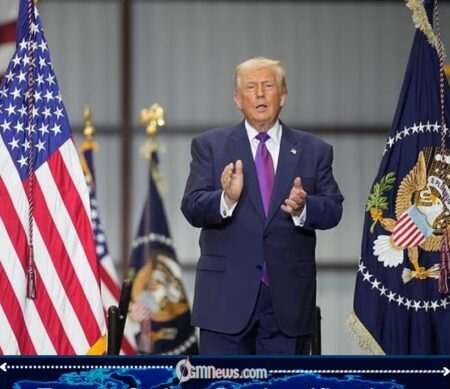
In response to what he described as “tremendous interest” from the public, U.S. President Donald Trump, currently serving his second term, has announced plans to release government files related to aliens, extraterrestrial life, unidentified aerial phenomena (UAP), and unidentified flying objects (UFOs). The directive, issued via his Truth Social platform, calls on Secretary of War Pete Hegseth to begin identifying and declassifying relevant materials.
The announcement came amid renewed national debate over transparency and the handling of classified information, particularly following recent public remarks by former President Barack Obama concerning the possibility of extraterrestrial life. Trump’s decision signals a potentially significant development in the government’s longstanding approach to one of the most enduring mysteries in American public discourse.
President Trump Directive on Disclosure
President Trump stated that he would be “directing the Secretary of War to begin the process of identifying and releasing Government files” connected to alien and extraterrestrial life, UAPs, and UFOs. He added that the administration aims to make public “any and all other information connected to these highly complex, but extremely interesting and important, matters.”
The scope and timeline of the proposed disclosures have not yet been detailed. It remains unclear how many documents could be affected or whether sensitive national security information would be redacted prior to release. Historically, government disclosures regarding unidentified aerial phenomena have involved a careful review process to balance transparency with defense considerations.
The announcement underscores Trump’s stated commitment to openness on issues that have generated decades of speculation, while also placing responsibility on relevant departments to ensure the orderly handling of classified material.
Dispute Over Classified Information
The directive followed remarks by Barack Obama during a podcast interview in which he was asked about extraterrestrial life. In response to a question from podcast host Brian Tyler Cohen, Obama remarked that aliens were “real,” though he added that he had not seen them and dismissed claims that extraterrestrials were being housed at a secret government facility.
President Trump later criticized Obama, stating that classified information should not be disclosed publicly. Speaking to Fox News reporter Peter Doocy aboard Air Force One, Trump said he was uncertain whether extraterrestrials exist but asserted that sharing classified material would be inappropriate.
Obama subsequently clarified his comments, explaining that he had seen no evidence during his presidency of extraterrestrial contact with Earth. He emphasized that his remarks reflected a general belief in the statistical likelihood of life elsewhere in the vast universe, rather than knowledge of confirmed contact.
Area 51 and the Legacy of Secrecy
Much of the public fascination with extraterrestrial life is tied to Area 51, a classified military installation in Nevada long associated with UFO speculation. The remote desert base became the subject of widespread rumors during the Cold War, when its secrecy and restricted access fueled theories of hidden government programs involving alien technology.
The U.S. government has acknowledged the existence of the facility, identifying it as a testing site for advanced military aircraft and defense systems. Officials have consistently denied claims that alien life forms are being housed there.
Despite official explanations, Area 51 remains a powerful symbol in American popular culture, representing the intersection of national security secrecy and public curiosity about the unknown.
White House Response and Internal Reactions
The president Trump’s comments were further amplified by media discussions and remarks from members of his extended family. Lara Trump said during a podcast interview that the president was preparing a speech related to extraterrestrials, though this information appeared to surprise White House officials.
At a subsequent press briefing, Press Secretary Karoline Leavitt said that a speech specifically focused on aliens would be “news” to her, but acknowledged public interest in the topic. She indicated that the administration would provide updates if formal plans were confirmed.
The exchange highlighted the dynamic nature of the discussion and the degree to which interest in extraterrestrial life has moved from fringe speculation into mainstream political conversation.
Scientific Perspective on Extraterrestrial Life
While political debate has intensified, scientists continue to approach the question of alien life through empirical research. Astronomers and astrobiologists generally focus on identifying “Earth-like” exoplanets orbiting distant stars within habitable zones, where conditions might allow liquid water to exist.
To date, no verified evidence has confirmed the existence of extraterrestrial life. However, advances in telescope technology and space exploration have expanded understanding of the universe’s vastness, reinforcing scientific consensus that the possibility of life elsewhere cannot be ruled out.
The president’s directive, if carried out extensively, could intersect with ongoing scientific inquiry by shedding light on decades of classified reports and observational data related to unexplained aerial phenomena.
Transparency, Public Curiosity, and National Security
The proposed release of government files touches on broader issues of transparency, accountability, and national security. Advocates of disclosure argue that the public has a right to review information concerning unexplained phenomena that have long generated speculation.
Critics caution that premature or poorly managed disclosures could compromise defense capabilities or misrepresent ambiguous data. Government agencies historically have taken a measured approach to declassification, particularly when materials involve military technology or intelligence operations.
As the review process begins, attention will likely focus on how the administration balances openness with the need to protect sensitive information. The outcome may shape public trust and redefine the government’s approach to one of its most enduring mysteries.

[…] […]