



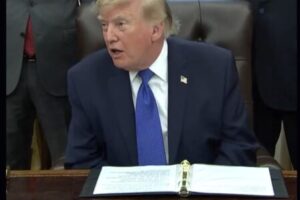















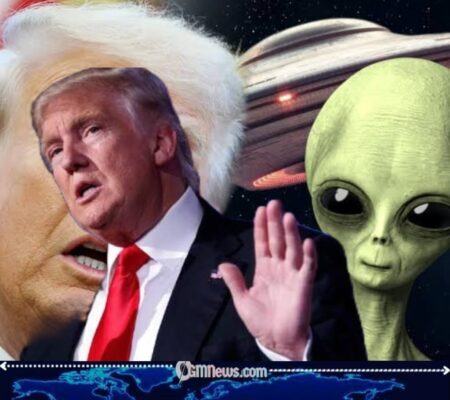
President Donald Trump signed a directive ordering the declassification of long-classified government files related to unidentified flying objects, now formally referred to by defense officials as Unidentified Aerial Phenomena. The move immediately reignited public debate over decades of secrecy, intelligence assessments, and unanswered questions surrounding aerial incidents investigated by the Pentagon and other federal agencies. The announcement was framed as part of a broader transparency initiative aimed at restoring public trust in federal institutions.
President Donald Trump stated that Americans “deserve to know what their government has documented,” emphasizing that the directive would not compromise national security but would instead clarify confusion that has fueled speculation for generations. He indicated that relevant agencies had been instructed to review classified material for expedited public release, subject to redactions necessary to protect sources and methods.
The order places pressure on agencies such as the Department of Defense and the intelligence community to balance transparency with operational security. While previous administrations authorized limited disclosures, this directive signals a more expansive review process that could include archival documents, internal memos, and previously restricted investigative findings.
Historical Context of Government UFO Investigations
President Donald Trump’s directive comes after years of incremental disclosures, including the establishment of a Pentagon task force to examine unexplained aerial sightings. Government investigations into UFO reports date back to the Cold War era, when officials sought to determine whether unusual sightings represented foreign surveillance or experimental technologies.
President Donald Trump referenced those historical programs in remarks surrounding the order, noting that public curiosity has only intensified as more military personnel have testified about encounters with unexplained objects. He suggested that decades of speculation have been fueled in part by inconsistent communication from federal agencies.
Earlier reports released by defense officials acknowledged that a limited number of sightings remain unexplained, though no evidence has confirmed extraterrestrial origins. Analysts stress that “unidentified” does not equate to “alien,” but rather indicates insufficient data to reach a definitive conclusion.
President Donald Trump and Public Accountability
President Donald Trump argued that declassification would help dispel conspiracy theories and bring clarity to a topic long clouded by secrecy. He framed the directive as a step toward institutional accountability, asserting that transparency strengthens democratic oversight.
President Donald Trump also stated that elected officials must ensure that classified programs remain aligned with constitutional principles. By encouraging broader disclosure, he suggested that policymakers can reduce misinformation and allow scientific experts to assess the available evidence objectively.
The announcement has prompted reactions from lawmakers across party lines, with some supporting expanded transparency and others cautioning that the release process must remain methodical. Legal experts note that declassification procedures require interagency coordination and careful review to prevent unintended exposure of sensitive capabilities.
National Security Considerations
President Donald Trump emphasized that the order would not undermine defense readiness or reveal tactical vulnerabilities. He directed agencies to protect intelligence sources while still making non-sensitive material accessible to the public.
President Donald Trump acknowledged that many sightings may ultimately be attributed to foreign drones, atmospheric phenomena, or advanced aerospace testing. Defense officials have repeatedly warned that adversarial nations are investing heavily in next-generation surveillance technologies.
Security analysts caution that public release of technical data must be carefully vetted to avoid revealing detection methods or radar capabilities. Balancing transparency with security remains a central challenge as agencies review decades of material.
Scientific and Public Reaction
President Donald Trump’s directive has drawn significant interest from scientists, historians, and independent researchers. Many experts welcome expanded access to raw data, arguing that empirical analysis is essential to separating fact from speculation.
President Donald Trump suggested that open review could encourage collaboration between government agencies and academic institutions. By providing researchers with credible documentation, he argued, policymakers can move the discussion from rumor to rigorous evaluation.
Public reaction has been mixed, ranging from enthusiasm among disclosure advocates to skepticism among those who doubt that new releases will provide groundbreaking revelations. Social media platforms have amplified debate, illustrating the enduring fascination with unexplained aerial phenomena.
Implications for Governance and Trust
President Donald Trump positioned the directive as part of a broader conversation about public confidence in government institutions. He contended that secrecy, even when justified, can erode trust if not periodically reassessed.
President Donald Trump maintained that restoring credibility requires proactive transparency, especially on issues that have generated sustained public speculation. He indicated that additional reforms could follow depending on the outcome of the declassification review.
Whether the release of UFO-related files reshapes public understanding remains uncertain. What is clear is that the directive has reopened a long-running national dialogue about secrecy, accountability, and the line between safeguarding national security and satisfying legitimate public inquiry.
[…] […]