


























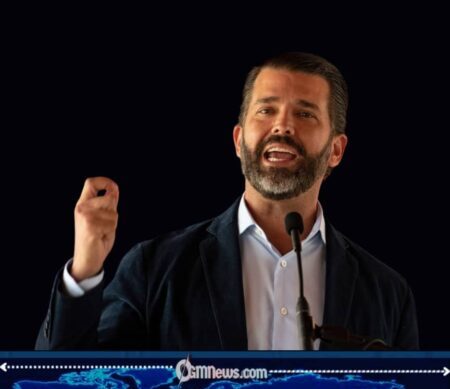
Donald Trump Jr. has moved to dismiss allegations of impropriety following reports that nearly half of a business venture known as World Liberty was sold to a member of an Emirati royal family after the U.S. election, a transaction critics suggest may have been designed to secure access to advanced artificial-intelligence semiconductor technology. He insists the deal is unrelated to government policy and says his father, Donald Trump—currently serving a second term as President of the United States—has no involvement in the matter.
The controversy has drawn scrutiny from ethics specialists, national-security analysts, and lawmakers, reflecting broader concerns in Washington over foreign investment, export-controlled technologies, and the boundaries between private enterprise and political influence.
Donald Trump Jr. Rejects Allegations of Political Influence
Donald Trump Jr. publicly addressed the matter in interviews, stating that his family has long navigated conflict-of-interest accusations and has established internal separations between private business activities and public office. He characterized the latest claims as “recycled narratives,” arguing that critics are attempting to link commercial transactions to policy decisions without evidence.
He emphasized that the president has no operational role in the company and does not participate in negotiations, governance, or financial arrangements tied to the reported stake sale.
According to his remarks, the investment reflects what he described as “standard international capital participation” rather than any attempt to influence U.S. export rules or gain privileged technological access.
Deal Structure and the Reported 49% Stake Sale
The reported transaction centers on a 49% share in World Liberty, said to have been acquired by an Emirati royal-linked investor. Such minority stakes are not unusual in global financing, particularly in capital-intensive sectors tied to digital infrastructure and emerging technologies.
However, the timing of the deal is coming after a U.S. election and amid tightening global competition over advanced AI chips—has prompted analysts to examine whether geopolitical considerations may intersect with private capital flows.
Financial experts note that foreign investors frequently seek exposure to U.S. technology ecosystems, which remain among the most lucrative and strategically important markets worldwide.
Donald Trump Jr. Says Business Operations Are Independent
Donald Trump Jr. maintained that the company’s activities are entirely commercial and insulated from federal decision-making processes. He argued that U.S. ethics frameworks already impose significant transparency requirements and that any suggestion of hidden influence misunderstands how such ventures are structured.
He further stated that his business dealings are reviewed by legal advisers to ensure compliance with applicable regulations governing foreign partnerships, investment disclosures, and technology-transfer restrictions.
Supporters of this position contend that private firms linked to politically prominent families often face heightened scrutiny regardless of whether substantive conflicts exist.
Ethics Experts Call for Transparency Amid Strategic Tech Competition
Governance specialists say the issue underscores longstanding tensions in Washington between private wealth, political proximity, and national-security priorities especially as artificial intelligence becomes a central arena of global rivalry.
They argue that even the perception of foreign stakeholders seeking access to sensitive technologies can raise reputational and policy concerns, particularly when export-controlled semiconductor technologies are involved.
Some experts advocate clearer disclosure mechanisms for politically exposed business leaders, suggesting that transparency—rather than prohibition—is the most effective safeguard in a globalized investment environment.
Donald Trump Jr. Pushes Back Against Narrative as Debate Continues
Donald Trump Jr. has framed the controversy as part of a broader political environment in which business ventures connected to high-profile public figures attract sustained examination. He reiterated that the president’s policy agenda is developed independently of family enterprises.
The discussion is likely to continue as policymakers weigh how to balance open investment climates with the protection of strategically significant technologies central to AI development and national competitiveness.
For now, no formal findings of wrongdoing have been announced, but the episode illustrates how commercial transactions can become focal points in wider debates over ethics, security, and globalization.
Casinoabc999? Good Site. The interface is sleek, and there is a lot of stuff to...