









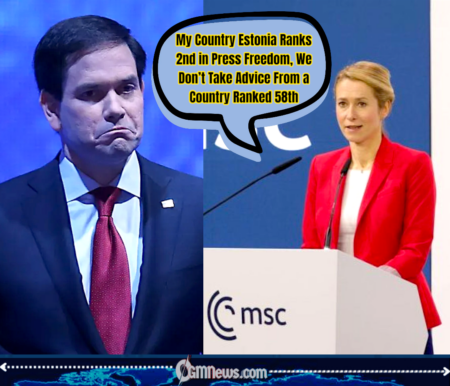
Munich, Germany – At the high-profile Munich Security Conference, European Commission Vice-President Kaja Kallas did not mince words in responding to U.S. Senator Marco Rubio’s recent speech on Europe’s role in “saving the West.” In a pointed Q&A session, Kallas highlighted Estonia’s global standing on press freedom while taking a subtle jab at the United States’ ranking, leaving attendees both amused and contemplative.
Kaja Kallas: European Values vs. European-Bashing
During the discussion, Kaja Kallas addressed Rubio’s speech, which suggested that Europe has a duty to help the United States in defending Western values. She noted that while some parts of the speech may have been directed at American audiences, the repeated “Europe-bashing” trend was difficult to ignore.
“I’m thinking of what is the alternative,” Kallas said, lightly rolling her eyes, “all the best things we have received from Europe, and all the good things Europe actually presents, are conveniently forgotten in these speeches.” She emphasized that Europe continues to represent human rights, progress, and prosperity—a message she believes the world observes with admiration.
The Vice-President’s tone carried a mix of irony and pride, highlighting Estonia’s success in media freedom. Ranked second globally in press freedom, Estonia stands in stark contrast to the United States’ 58th place ranking, making Kallas’ gentle critique of Rubio resonate with a subtle punchline for journalists and policymakers alike.
Kaja Kallas’s Diplomatic Roast With a Smile
Kaja Kallas didn’t stop at statistics. She underscored the irony of hearing critiques from a nation struggling with media liberties, humorously noting that advice about press freedom from a 58th-ranked country “is interesting,” to say the least.
Yet, despite the ribbing, Kallas maintained a diplomatic tone, reiterating that Europe and the U.S. remain intertwined historically and strategically. “We don’t see eye to eye on all issues,” she acknowledged, “but there is a foundation to work from, and frankly, it’s one worth preserving.”
Observers noted that while Rubio’s speech was framed as an appeal for European assistance, Kallas’ response turned it into a teachable moment on perspective, soft power, and the enduring strength of European institutions.
Looking Forward: Cooperation Amid Differences
The dialogue also revealed a nuanced understanding of transatlantic relations. Kaja Kallas recognized that while disagreements exist, the overarching bond between Europe and the U.S. persists, especially when facing global challenges.
This balanced view, combining critique with reassurance, reflects the evolving nature of European diplomacy: firm when principles are challenged, humorous when irony allows, and pragmatic when cooperation is essential. Analysts suggest that Kallas’ approach may set a tone for future U.S.–Europe interactions, signaling that respect and subtle humor can coexist in even the most high-stakes discussions.
Kaja Kallas Match Rubio’s High Politics
The session left the audience with smiles, as Kaja Kallas’ remarks combined a reality check with a wink. The subtle jab at U.S. press freedom rankings, alongside a nod to the historical interconnectedness of Europe and America, reminded attendees that political discussions need not always be dour—sometimes, a little humor makes the message stick.Kaja Kallas concluded by emphasizing shared values over rhetoric, demonstrating that even in international diplomacy, wit can be an effective tool alongside data and principles.
https://shorturl.fm/XPOeg