









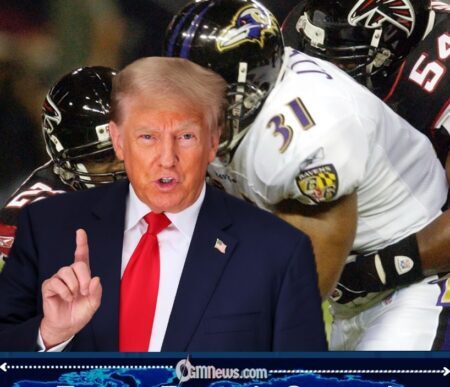
President Donald Trump, the current U.S. president serving a second term, has pardoned five former National Football League players for crimes ranging from perjury to drug trafficking. The clemency decisions, announced on Thursday, drew attention not only because of the high-profile recipients but also due to the Trump administration’s continued emphasis on criminal justice relief and second chances.
The pardons were revealed by White House pardon adviser Alice Marie Johnson, who described the move as consistent with a broader philosophy of redemption and national renewal. The beneficiaries include Joe Klecko, Nate Newton, Jamal Lewis, Travis Henry, and the late Billy Cannon, who received a posthumous pardon. The White House did not provide additional details on the rationale behind the decisions.
Clemency Announcement and President Trump Administration Philosophy
The pardons were formally announced by Alice Marie Johnson, who has played a prominent role in advocating clemency cases under the Trump administration. In a statement shared on the social media platform X, Johnson framed the decision in symbolic terms, linking the resilience often celebrated in football to the ideals of redemption in public life.
“As football reminds us, excellence is built on grit, grace, and the courage to rise again. So is our nation,” Johnson wrote. She thanked President Trump for what she described as his “continued commitment to second chances,” adding that “mercy changes lives.”
Although President Trump is known as an avid sports enthusiast, the White House did not respond to inquiries regarding specific reasons for selecting these individuals for clemency. The announcement nonetheless underscores the Trump administration’s readiness to use executive pardon powers in high-profile cases.
Joe Klecko: From Hall of Fame to Presidential Pardon
Joe Klecko, a celebrated defensive lineman best known for his tenure with the New York Jets, was among those granted clemency. Klecko had previously pleaded guilty to perjury after admitting that he lied to a federal grand jury investigating an insurance fraud case.
Despite his legal troubles, Klecko’s football legacy remains significant. A two-time Associated Press All-Pro and four-time Pro Bowler, he was inducted into the Pro Football Hall of Fame in 2023, cementing his status as one of the premier defensive players of his era. The pardon removes a legal blemish from an otherwise distinguished sporting career.
Nate Newton: A Super Bowl Champion’s Legal Struggles
Nate Newton, a former offensive lineman for the Dallas Cowboys, also received a presidential pardon. Newton pleaded guilty to a federal drug trafficking charge after law enforcement discovered $10,000 in his pickup truck and 175 pounds of marijuana in a vehicle driven by an associate.
Newton’s football résumé includes three Super Bowl victories, two All-Pro selections, and six Pro Bowl appearances. According to Johnson, Dallas Cowboys owner Jerry Jones personally informed Newton of the clemency decision. The pardon marks a significant legal development for the former lineman, whose off-field issues contrasted sharply with his on-field success.
Jamal Lewis and Travis Henry: Redemption After Drug Convictions
Jamal Lewis, formerly of the Baltimore Ravens and Cleveland Browns, pleaded guilty in a drug case involving an attempted deal shortly after entering the league as a top draft pick in 2000. Lewis later became one of the NFL’s premier running backs, earning All-Pro honors and being named the Associated Press Offensive Player of the Year in 2003.
Travis Henry, who played for three teams including the Denver Broncos, pleaded guilty to conspiracy to traffic cocaine after financing a drug distribution operation between Colorado and Montana. A one-time Pro Bowler, Henry’s professional achievements were overshadowed by his legal issues. The pardons for both men signal a willingness by the Trump administration to extend clemency in cases involving drug-related offenses.
Billy Cannon: Posthumous Clemency for a College Legend
Billy Cannon, who died in 2018, was granted a posthumous pardon. Cannon had admitted to counterfeiting in the mid-1980s after financial setbacks left him facing mounting debts. His legal troubles followed a celebrated football career that spanned both college and professional ranks.
Cannon won the 1959 Heisman Trophy while starring at Louisiana State University, where he produced one of the most iconic plays in college football history—an 89-yard punt return for a touchdown against Ole Miss. In the professional ranks, he played for the Houston Oilers, Oakland Raiders, and Kansas City Chiefs, earning two All-Pro selections and two Pro Bowl appearances.
Executive Authority and Public Reaction
The U.S. Constitution grants the president broad authority to issue pardons for federal offenses, a power that has historically been used to address perceived injustices, recognize rehabilitation, or signal policy priorities. President Trump’s decision to pardon the five former players reflects this constitutional prerogative.
Public reaction has been mixed. Supporters argue that clemency can provide closure and reinforce the principle that individuals deserve opportunities to rebuild their lives. Critics question the criteria used in selecting high-profile figures, noting the absence of detailed explanations from the White House. As with many exercises of presidential pardon power, the decisions have sparked renewed discussion about transparency and equity in the clemency process.
The weekly tournaments here keep me coming back because the prize pools are surprisingly generous....