














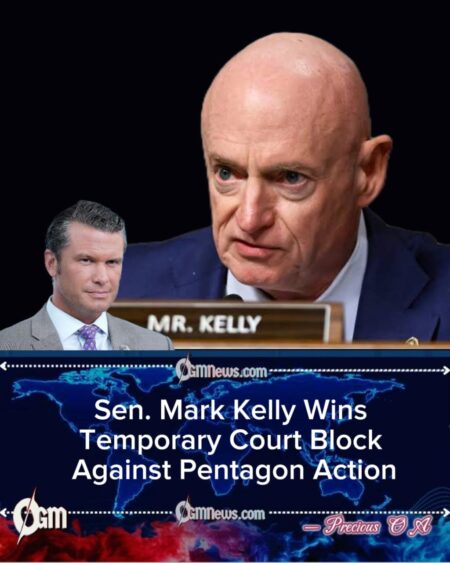
Sen. Mark Kelly is at the center of a new federal court ruling after a judge blocked efforts by Defense Secretary Pete Hegseth and the Pentagon to pursue disciplinary action related to a video in which Kelly stated that service members have the right to refuse unlawful orders. The ruling temporarily prevents any punitive measures while the case proceeds.
Sen. Mark Kelly had posted the video addressing members of the armed forces, emphasizing longstanding military law principles that personnel are obligated to follow lawful commands but are not required to carry out orders that violate U.S. law or the Constitution. His remarks sparked debate over the boundaries between civilian oversight, military discipline, and free speech.
The legal dispute emerged after Pentagon officials indicated that Kelly’s statements could undermine command authority or create confusion within the ranks. Supporters of Kelly argued that he was referencing established military doctrine rather than encouraging insubordination.
Background of the Dispute
Sen. Mark Kelly defended his comments by pointing to the Uniform Code of Military Justice and historical precedents that affirm a service member’s duty to refuse manifestly illegal orders. He stated that his message was intended as clarification, not confrontation.
Sen. Mark Kelly critics within the defense establishment reportedly viewed the video as potentially disruptive, particularly given the highly structured chain-of-command system governing military operations. Pentagon representatives expressed concern about maintaining discipline and unity.
Legal scholars note that the principle of refusing unlawful orders is deeply embedded in both domestic military law and international humanitarian law. However, public discussions of the issue by elected officials can raise sensitive questions about timing, context, and interpretation.
Legal Arguments Surrounding Sen. Mark Kelly
Sen. Mark Kelly’s legal team argued in court filings that any attempt to sanction him would infringe upon constitutional protections, including free speech and legislative immunity. They contended that his remarks fell squarely within permissible public commentary on matters of law and governance.
Sen. Mark Kelly’s attorneys further maintained that federal courts have historically protected lawmakers from executive retaliation tied to policy disagreements. The judge’s order appears to align with that reasoning, at least at this preliminary stage.
The court emphasized that the ruling does not determine the ultimate merits of the case but instead preserves the status quo pending further review. Temporary injunctions are common in disputes involving constitutional questions.
Pentagon Response and Institutional Concerns
Sen. Mark Kelly’s statements have drawn a careful but measured response from Pentagon leadership. Officials reiterated that service members are trained extensively in recognizing lawful versus unlawful orders and that internal channels exist for raising concerns.
Sen. Mark Kelly has continued to assert that reinforcing legal obligations strengthens, rather than weakens, military professionalism. He has argued that clarity on legal standards protects both service members and the institution itself.
Defense analysts caution that public disputes between lawmakers and defense officials can risk politicizing military issues. Maintaining a nonpartisan military structure remains a central principle of U.S. civil-military relations.
Broader Constitutional Context
The dispute highlights the constitutional balance between Congress and the executive branch in matters involving national defense. While the president serves as commander-in-chief, Congress retains oversight authority and legislative power over military affairs.
Historically, federal courts have intervened when questions arise about constitutional limits or potential overreach. The judiciary often acts as an arbiter when branches of government contest authority.
Legal experts observe that cases involving speech, military discipline, and separation of powers tend to carry broader implications beyond the immediate parties involved.
What Comes Next
The injunction means no disciplinary action can proceed while litigation continues. Both sides are expected to submit additional arguments clarifying the scope of authority and the constitutional protections at stake.
Future hearings may examine whether Kelly’s remarks had demonstrable impact on military operations or whether they remain within the realm of protected political speech. Courts typically weigh evidence carefully in such determinations.
As the case advances, it may set important precedents regarding the intersection of congressional speech and executive enforcement authority. For now, the ruling underscores the judiciary’s role in maintaining institutional balance when disputes arise at the highest levels of government.
[…] […]